If your refrigerator became warmer after you turned the freezer control colder, check whether that control adjusts airflow rather than an independent temperature. On some shared-air designs, it changes how cold air is divided between compartments. Turning both controls to their coldest positions is not a reliable correction. Identify their jobs, restore the appropriate normal settings, and compare actual temperatures before making another change.
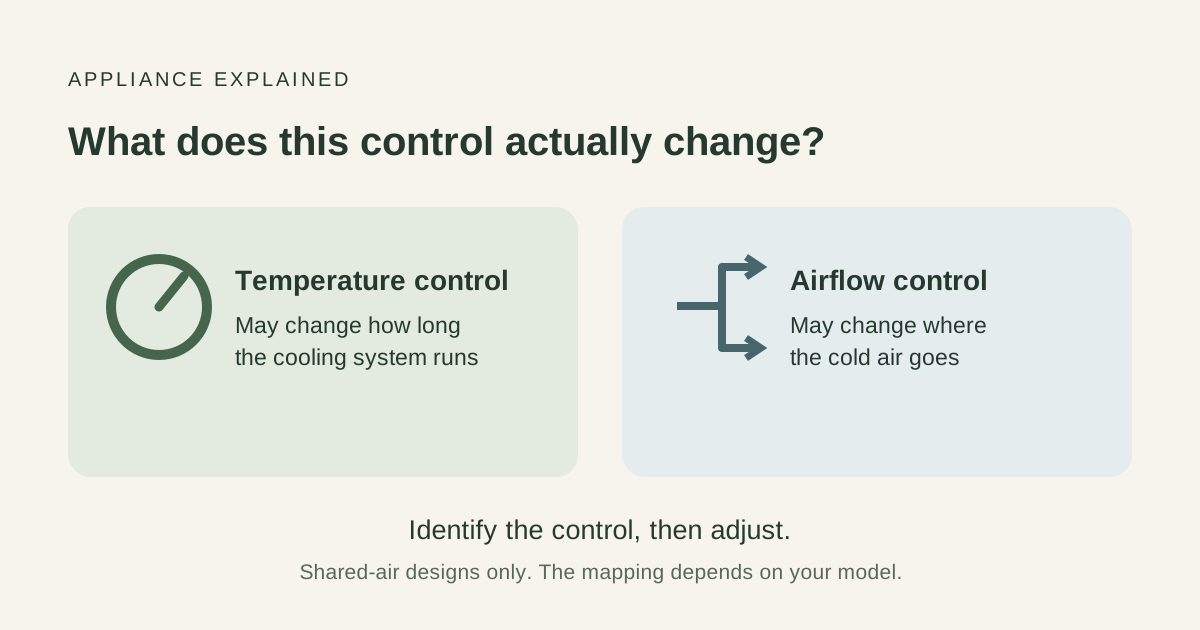
This explanation applies to refrigerators with separate temperature and airflow controls. It is not a universal instruction for digital panels or independently controlled compartments.
Two knobs do not necessarily mean two thermostats
One control may determine how long the cooling system runs; the other may move a damper that regulates air between compartments. That distinction matters when the freezer feels colder but milk in the refrigerator does not.
On certain GE top-freezer refrigerators and older side-by-side designs, the fresh-food control determines compressor runtime while the freezer control operates the damper. Other GE control arrangements reverse those roles. The compartment name printed beside a knob therefore does not, by itself, tell you how it works.
For these mechanical control arrangements, an OFF marking helps identify the control governing compressor runtime. Read the label; there is no need to switch cooling off to test the idea. Confirm the arrangement for your exact model before changing settings.
Identify the job first.
When Max sends more air to the freezer
Some Whirlpool top-freezer refrigerators have a temperature control near the top front of the refrigerator compartment and a separate airflow control on the freezer's back wall. On the configuration with Min, Recommended and Max airflow settings, the directions mean:
| Airflow position on this configuration | What it changes | What it does not establish |
|---|---|---|
| Max | Increases airflow to the freezer | That the refrigerator compartment will become colder |
| Min | Increases airflow to the refrigerator | That cooling capacity or a failed component has been repaired |
| Recommended | The normal position to return to after a temporary adjustment has achieved its purpose | An exact measured temperature |
Do not transfer this mapping to a different panel just because it also says “Max.” Match the airflow-control layout and your model's instructions. A similarly named temperature control can have a different purpose.
Make the next adjustment informative
Start by noting which control you changed and its previous position, if you remember it. If you moved both, say so. That history is more useful than another unexplained turn toward “colder.”
Check the accessible air openings before changing the settings again. Packages against a vent can restrict circulation even when the controls are in their normal positions. Move the obstruction without removing a cover or reaching into a fan opening.
For the Whirlpool top-freezer temperature controls described here, adjust one setting at a time, then allow 24 hours between temperature adjustments before checking again. This is a stabilization interval for the setting change, not permission to keep perishable food in a warm compartment.
Keep both compartment readings in the same note. The question is whether the refrigerator improves while the freezer also remains at its proper temperature. A control position alone cannot answer that.
If you cannot identify an airflow control, do not invent one from the number of buttons on the display. Use the model's normal settings and troubleshooting instructions.
When turning both controls colder has already failed
A Frigidaire LFTR1814LB illustrates the limit of this approach: moving the controls colder helped initially, but with both at their coldest positions the freezer was still around 32°F and the refrigerator around 42°F. Air was still coming from the freezer vents, and no obvious vent obstruction had been found.
Those were temperatures during an unresolved problem, not recommended targets. The useful conclusion is narrow: another colder setting had not restored cooling. The observations did not establish which part was faulty, and they do not show that this Frigidaire has the Whirlpool airflow arrangement above.
If that resembles your situation, preserve the setting-and-temperature history for service. Do not turn a failed control adjustment into a guessed parts diagnosis.
Where this control check ends
If the settings are identified and corrected but the refrigerator remains warm, move on from the knob question. For a cold freezer with a warm refrigerator, use the compartment-airflow guide. If both sections are warm, start with the broader cooling checks.
Leave control housings and internal panels in place. A visible setting is an owner check; deciding whether a damper, sensor or cooling component has failed requires a different inspection.
Questions about the freezer control
Does a higher number always make the refrigerator colder?
Not without identifying the control. A numbered temperature control and an airflow selector do different jobs. Follow the direction specified for the control on your appliance.
Should I leave the airflow selector at Min?
Not as a universal fix. On the Whirlpool arrangement described above, Min temporarily directs more airflow to the refrigerator. Return the airflow selector to Recommended after the intended improvement is achieved.
Can I tell the food temperature from the dial position?
No. A dial position is a setting, not a thermometer reading. Check the actual compartment temperatures after the appropriate stabilization period.
The next useful step is a controlled change whose result you can measure. Turning everything to maximum removes that clarity.