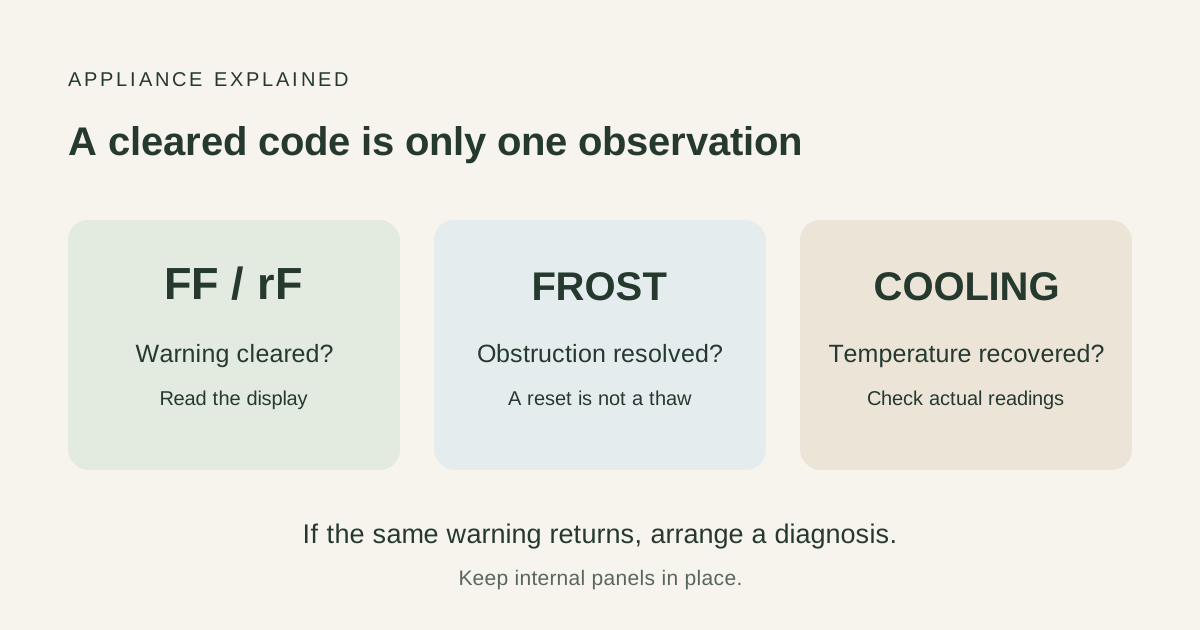
An LG refrigerator showing FF or E FF has detected abnormal freezer-fan operation; rF or E rF points to the refrigerator-compartment fan. A short power reset may clear the warning, but that does not prove that cooling has recovered or that ice around a fan has melted. Keep the exact code, the affected compartment and the result after restarting separate. If the same warning returns, arrange service rather than repeating resets indefinitely.
Read the complete code before choosing a remedy
The prefix can vary between displays: a code may begin with E, r or Er. The letters identifying the problem matter more than that variation.
| What you can read | What the warning concerns | What you cannot conclude from it |
|---|---|---|
| FF, E FF or Er FF | Freezer fan operation | That buying a new fan motor will solve the problem |
| rF or E rF | Refrigerator-compartment fan operation | That the freezer fan is the component at fault |
| IF | Ice-maker fan operation | That this is the same warning as FF |
| O FF or OFF | Cooling is disabled in Demo Mode | That the letter O is an E or a fan-fault diagnosis |
Take a clear picture before cutting power if the code is visible. It prevents a later guess about whether the display said FF, rF or IF. Do not enter an unfamiliar diagnostic mode just to reproduce a code.
An LMX25981ST illustrates why that first letter matters. Unplugging and reconnecting it had not cleared what looked like a fan warning. The display was actually O FF. Leaving Demo Mode resolved the problem after unnecessary attempts to investigate internal parts. If your display says O FF, use the Demo Mode exit instructions for your exact model; do not start an FF fan-repair sequence.
Read the whole display.
Separate resetting from thawing
For the E FF and E rF reset procedure, disconnect power and wait about 5 minutes before reconnecting, provided this matches the instructions for your appliance. Use an accessible plug or the refrigerator's dedicated breaker. You do not need to remove an appliance panel to reset power.
An FF warning can also occur when ice or frost prevents the fan from moving normally. Interrupting power and melting that obstruction are different actions. If the display clears after a restart, the only immediate result you have confirmed is that the warning is no longer showing.
Whether the compartment is cooling must be checked separately. If you have already tried the reset and the same code has returned, give that sequence to the technician instead of starting the same test again.
A temporary recovery can become a recurring fault
An LG LFC25760ST showed this distinction clearly. Disconnecting it for more than 4 hours generally cleared Er FF and allowed cooling to resume. What had been an occasional problem later returned at least weekly over a 2-month period. Checking that the refrigerator was level had not prevented the recurrence.
That sequence does not establish a failed motor or prove that hidden ice was responsible. There was no confirmed repair outcome. It does establish something useful for your next decision: cooling after a long unplug period is not the same evidence as a fault staying away.
If your pattern is similar, tell service how long power was disconnected, whether cooling returned, and how soon the warning reappeared. “It works after a reset” leaves out the part that needs investigating.
Do not combine different thawing instructions into one timer
Manual defrosting means disconnecting power and leaving the doors open so ice can melt. It is not the same operation as the 5-minute reset. For the standard-model ER FF/ER rF defrost procedure, allow at least 24 hours with both doors fully open, then a separate 24–48 hours after restarting for normal cooling to return. Confirm the procedure for your exact appliance before starting; heavy ice can take longer.
An 8-hour minimum appears in a separate FF troubleshooting procedure, but that shorter interval is not a universal substitute for the longer ER FF/ER rF procedure. Follow the applicable instructions as a whole. Do not combine the shortest number from one procedure with the restart steps from another.
Move food to reliable cold storage before disconnecting power. Place towels to catch meltwater and dry the interior before restarting. Let ice thaw naturally; do not use a hair dryer. If you cannot safely accommodate that interruption, arrange service instead.
Do not convert a short reset into a promise of a complete thaw. Do not use a disappearance of the code as your food-storage test, either.
For the difference between a selected temperature and an actual reading, see why an LG display can look colder than the compartment.
A new fan and a clear display can still leave warm food
On an LTCS20020W/00, cleaning the condenser coils had not restored refrigerator cooling. A freezer-fan replacement cleared the warning, yet the next morning brought freezer frost and an even warmer refrigerator. Cooling recovered only after a subsequent unplugged, doors-open thaw lasting about 15 hours. That was the outcome on this appliance, not a recommended defrost duration for yours; the suspected hidden ice was not a confirmed component diagnosis.
The opposite limit matters too. An LRFXC2606S had already stood defrosting for days while a replacement fan was awaited. After the replacement, its diagnostic check reported no problem and the freezer held 0°F, but the refrigerator remained around 50°F rather than the intended 37°F. No successful final repair was established. A running replacement fan and a clear diagnostic result had not demonstrated adequate cooling in the refrigerator.
Treat these as separate observations: warning cleared, fan operating, compartment cooling. After completed repair work, a warm refrigerator still needs follow-up even when the first two observations look better. Do not order another part solely from the code.
There is a location trap as well. An LRFWS2906S had an FF warning while a fan visible behind the appliance was still running; cleaning dust there brought no improvement. That visible motion did not establish that the freezer fan identified by FF was working. Keep the covers in place and pass the exact warning to service, rather than using an unrelated fan's motion to dismiss it.
Check the result that matters: actual cooling.
What changes the next step
If the same fan warning returns after the applicable reset, or remains after the model's defrost procedure, request a diagnosis. Keep internal fan covers in place; the warning identifies an operating problem, not an owner-approved replacement procedure.
If there is no fan warning and the main symptom is simply a warm refrigerator with a cold freezer, use the cold-freezer, warm-refrigerator checks. An FF troubleshooting sequence should not be applied to every cooling problem.
Questions after the warning clears
Does FF mean the compressor has failed?
FF identifies the freezer-fan problem detected by the controls. It does not, by itself, diagnose the compressor. Preserve the code rather than translating it into a different fault.
Is a repeated reset a repair?
No. A reset can be a troubleshooting step. A warning that keeps returning still needs its cause identified, even if the refrigerator cools between occurrences.
Can I put the food back as soon as the display looks normal?
Use the actual storage temperature, not a cleared display, to decide whether the compartment is ready. Keep food in reliable cold storage while cooling recovers.
Why is there a waiting period after defrosting?
Melting frost happens with cooling switched off. The refrigerator then has to cool its compartments again after power returns. Those are separate stages, so write down both times rather than calling the whole interruption a reset.
The useful outcome is restored cooling that lasts. A quiet display is only part of that check.