Pause a washing machine that shakes violently or walks across the floor. Once the drum stops and the door or lid unlocks, check the load. If the washer was recently installed or moved, have its transport supports checked; if the cabinet rocks while stopped, check its feet and floor support. A centered bubble on a level does not establish that all four feet are carrying the machine securely.
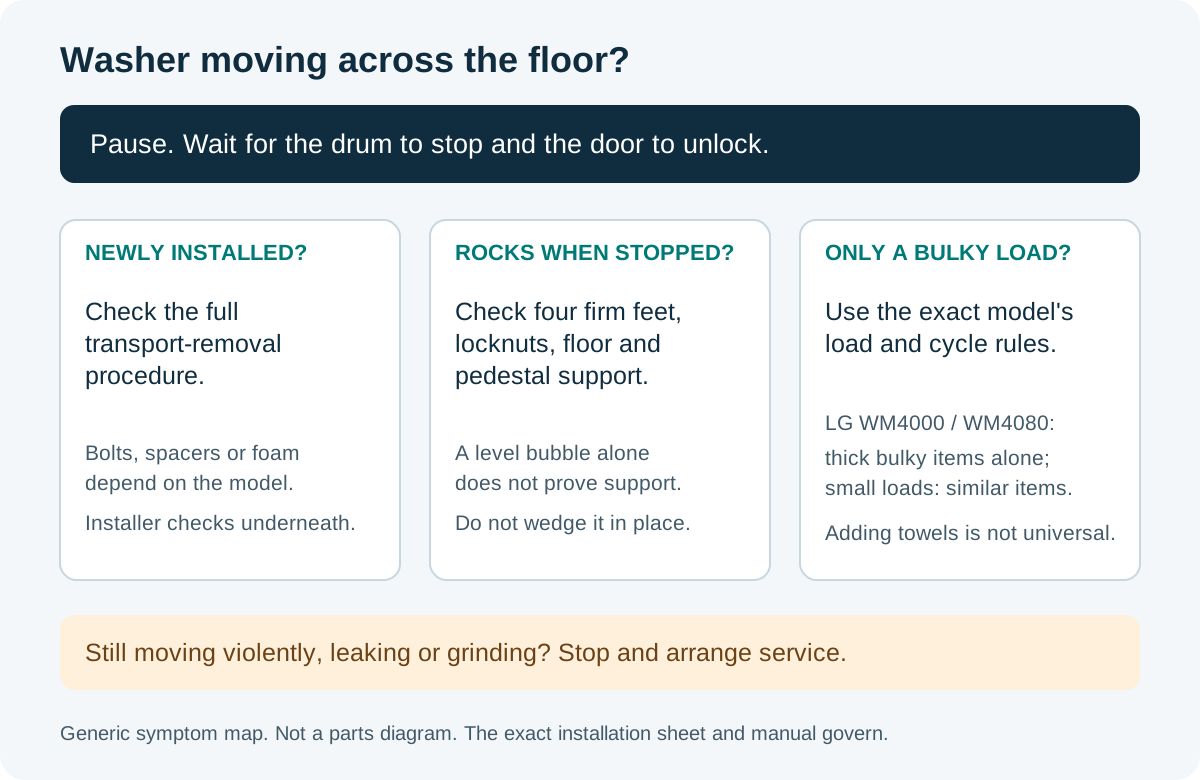
Do not hold the washer in place during a spin or keep restarting it to see whether it settles. Stop using it if movement strains the hoses, water leaks, or you hear scraping or grinding. Leave a door that is still locked alone; the locked washer door guide explains the safe next checks.
Did the shaking start after installation or a move?
A front-load washer can be level while its tub is still restrained by shipping hardware. Check the installation sheet for the complete transport-removal procedure. Looking for a few missing metal bolts is not enough if the procedure also identifies sleeves, spacers or packing supports.
LG's vibration guidance also identifies foam support beneath the washer. If checking it requires pulling out or tilting a heavy machine, have the installer do that work. Do not tip a stacked pair or reach underneath an unsupported appliance.
The transport arrangement varies. Do not remove an unfamiliar fastener merely because another washer has shipping bolts in that location. For a new installation that has never completed a stable wash, give the installer the model number and ask them to verify the entire preparation and support setup.
It is level, but does the stopped cabinet rock?
With the washer stopped, gently check whether the cabinet rocks diagonally. A machine can appear level but still have one foot barely touching the floor. Recheck the level both side to side and front to back, then follow the manual for adjusting the feet and securing their locknuts.
Keep adjustable legs as short as the installation allows. All four feet need firm support; the floor beneath them matters as much as the bubble reading. If a floor flexes, the installation needs attention even when the washer itself is level.
Do not use loose blocks, wedges or an improvised soft mat to trap a moving washer. Ask the installer about the floor and any approved support arrangement. Pads will not establish whether the load, installation or an internal component is responsible.
Check the pedestal or stacked installation
For a washer on a pedestal, follow the pedestal instructions as well as the washer instructions. The pedestal must be stable and the washer correctly secured to it. Adjusting only the washer's visible position can leave a problem at the mounting points underneath.
Remove loose objects from a pedestal drawer if they are rattling, but distinguish that noise from the whole appliance moving. Have an installer check a stacked pair's approved mounting arrangement. Adding weight on top or wedging the machines against nearby cabinetry is not a repair.
Does it happen with one blanket or a small load?
Wait for the drum to stop and unlock, then separate tangled laundry. Check that the load fits freely and that the chosen cycle matches the items. A bulky article and a small load need different decisions.
On LG WM4000 and WM4080 series washers, wash thick, bulky items individually. The manual includes heavy blankets, comforters, bedspreads and pet beds in that guidance. Its Bedding instructions also warn against mixing bedding with other laundry. Do not automatically add towels to a comforter that is already filling the drum; the load must have room to move.
For a small load on those models, the manual instead advises adding similar items to help distribute the weight. Use the appropriate cycle and follow the fabric care instructions. If the item cannot fit with the space required by the manual, use a suitable larger machine.
Other washers have different bulky-load instructions. Use the rule for your model rather than treating either "add towels" or "wash it alone" as universal. If the main problem is wet clothes without the cabinet moving, start with the washer not spinning guide.
Does your Samsung model call for calibration?
Some Samsung washers provide Calibration Mode to establish load sensing. Use it only when your model's manual specifies it, with the drum empty. The button sequence differs across models, so a combination copied from another control panel may not apply.
Calibration comes after checking installation and support. It cannot release shipping restraints or make an unstable pedestal secure. If the washer still moves excessively after the prescribed checks, stop and request service.
A Maytag HE washer pauses, fills and gently turns
On Maytag HE top-load washers covered by the imbalance guidance, adding water and gently rotating can be an attempt to redistribute the load. That sequence alone does not establish a new fill or drain fault. If it cannot rebalance, follow the model's cancel, drain and load-redistribution instructions. Violent cabinet movement still calls for stopping. The fill-and-drain guide separates redistribution from other water behavior.
Water sounds when an LG top-load tub moves
On LG top-load washers with a sealed fluid balance unit, a sloshing sound can come from that unit. Do not open or drain it to fix vibration. Sound alone is different from visible wash water remaining in the tub; for the latter, use the washer not draining guide.
When the checks do not stop the movement
Arrange service if excessive movement returns after the load and installation checks, especially if the drum appears off-center or there is grinding. Do not deliberately repeat a violent spin to collect evidence. A quiet empty spin, if you have already observed one, does not prove the washer will behave normally under load.
One LG WM4370HKA owner reported that replacing shocks and then springs did not resolve loaded vibration, even though an empty spin was quiet. That unresolved experience is a reason to describe the conditions to a technician, not a parts list to copy.
For the service request, record whether the problem began after a move, which load and cycle triggered it, and whether the cabinet moved or only made noise. Include any display message and the installation checks already completed. Those details are more useful than repeatedly changing parts or raising the spin speed to provoke the fault.