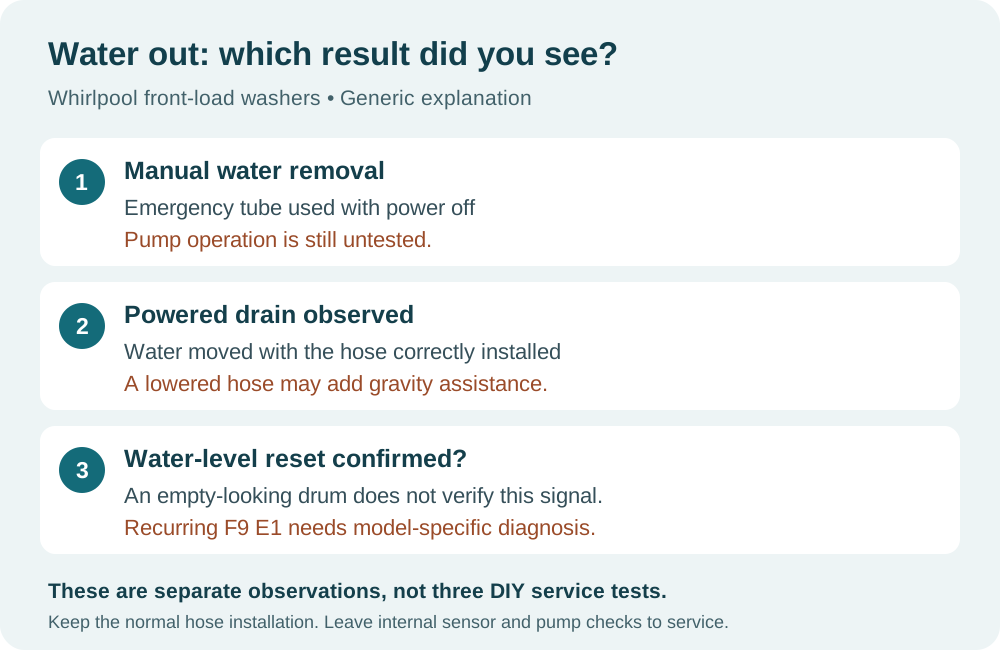
If a Whirlpool front-load washer reports F9 E1 even though water came out, first identify how it drained. Emptying it through an emergency tube does not test the pump. Water flowing through a lowered rear hose may be gravity-assisted. Even a powered drain does not, by itself, establish that the control received the required water-level signal.
F9 E1 is a long-drain warning, not an instruction to replace a particular part. This guide covers the apparent contradiction on front-load washers. Top loaders and all-in-one washer-dryers have their own instructions; use the exact model's manual for code meanings and controls.
What does “it drains” mean in your case?
| What actually happened | What you have established | What remains unproven |
|---|---|---|
| Water came out through the small emergency tube while the washer was unplugged | You manually removed water through that route | Whether the drain pump can empty the washer |
| Water ran out after the rear hose was lowered | Water can leave in that altered position | Whether powered drainage works at the required installation height |
| Water visibly left during the washer's drain command, with the hose installed correctly | The machine moved water during that attempt | Whether it drained sufficiently, met the control's timing requirement, or will do so on the next cycle |
| The drum looks empty but F9 E1 returns | No pool is visible through the door | Whether the water-level detection system has reached its required reset state |
Do not lower or disconnect the hose to create a test. If it was moved during earlier troubleshooting, restore the installation specified for your model before interpreting a successful drain. Whirlpool's front-load guidance warns that a standpipe below 39 inches can let water leave by gravity. Its F9 E1 page also specifies no more than 4.5 inches of hose insertion, an air gap, and a maximum drain height of 96 inches. Check your installation manual before changing anything.
If you emptied it by hand, the pump question is still open
Manual draining can make the laundry accessible without resolving the fault that stopped the cycle. Do not report “the pump works” solely because the emergency tube produced water.
Filter access varies. Use only the owner-accessible drain/filter procedure in your manual, with power disconnected and the water cool. If reaching it requires cabinet removal or moving a stacked dryer, arrange service. The washer drainage guide covers the basic water, filter and hose checks.
A hum is also incomplete evidence: it does not measure water flow. If you can safely observe the normal drain outlet without disconnecting anything, record whether water actually moves during the commanded drain. If the outlet is concealed, tell the technician that flow was not observed.
If the pump moved water, why can F9 E1 remain?
The control's view of the water level matters as well as the water you can see. In the front-load platform described by Whirlpool technical sheet W10254472A, F9 E1 is tied to exceeding the drain-time limit without the pressure sensor reaching its reset level. The sheet includes the pressure hose among the checks for a restriction, kink or air leak.
That gives a technician another path to investigate when the drum appears empty. It does not prove the sensor is faulty, or establish that this technical sheet matches your washer. The technician needs the sheet for the exact model and must check the pressure-sensing path, drainage and relevant connections before selecting a part.
Leave those internal checks to service. Blowing into a sensor hose, probing live connectors or replacing a board is not the next owner check.
Check whether the displayed code is actually F8 E1
A continuously running pump and an unresponsive control panel can belong to a different sequence. On the front-load washers covered by Whirlpool's F8 E1/Lo FL guidance, the code concerns inadequate incoming water. Pressing Power starts a drain routine that can run for 8–10 minutes while the controls do not respond.
For that specified code and behavior, allow the routine to finish if there is no leak or other hazard. Then check the water-supply conditions in the model's instructions, including both supply taps. Photograph the code rather than relying on memory.
This is not a general instruction to wait out every F9 E1 fault. If the display really says F9 E1, use the long-drain checks; if it changes, record both codes and their order.
Two dosing details worth checking before ordering parts
Excess suds can prolong drainage. Check for foam and confirm that the detergent is HE and the dose suits the load and product concentration.
With a bulk dispenser, also check its concentration setting. The setting must match the detergent in the reservoir. A correct-looking detergent choice does not establish that the automatic dispenser is delivering the intended dose.
If the trouble followed a bleach change, check the product type. Whirlpool identifies thickening agents in some “no splash” or “easy pour” liquid bleaches as a possible source of excess suds. Do not assume foam must come from the laundry detergent alone.
Correct the product or setting according to the manual. Do not add repeated cleaning cycles to a washer that cannot reliably empty, and do not treat a dosing correction as proof that every recurring F9 E1 has been repaired.
What happened on four individual washers
These are owner-reported histories, not instructions to buy the same parts. They show why the result of an earlier attempt needs to be described precisely.
| Washer or reported condition | Earlier attempt and remaining problem | Reported follow-up |
|---|---|---|
| WFW87HEDW1, intermittent F09 E01 and humming without drainage | The hose and filter were clear, but a diagnostic drain failed with water still inside. After power was interrupted, it later drained quickly | The owner subsequently reported that replacing the pump fixed the problem. That brief recovery had not established a lasting repair |
| WFW5620FW0, F9 E1 during a drain/spin problem | Filter cleaning, flushing the pump and clearing codes did not solve it | The owner later reported that a pressure-sensor replacement also failed. The final cause remained unresolved |
| WFW72HEDW0, trouble after washing a rug that shed backing | Filter cleaning was followed by one successful wash, then recurrence. A pump replacement did not immediately produce normal operation | A technician later let the sequence finish, checked operation and cleared codes after the earlier cleaning and repairs. Several things had changed; this does not establish that waiting alone fixed it |
| Whirlpool front loader, exact model not stated, intermittent E01 F09 | The owner reported a clear filter and hose, with the slow-drain problem still recurring | A later update reported success after pump replacement. The account does not establish how to diagnose another machine |
Two accounts ended with a reported pump fix; another remained faulty after a sensor change. The rug case involved debris, repairs and a technician's subsequent checks. None makes an intermittent successful drain a reliable parts diagnosis.
Give service the result, not just “it drains”
Use a short description such as: “I emptied it through the emergency tube,” “I observed water at the normal outlet during Drain & Spin,” or “I heard the pump, but could not see the outlet.” Add the model, exact code, cycle stage, foam, and whether the error returned after an apparently successful attempt.
If F9 E1 recurs after the permitted external checks, stop repeating cycles and arrange service. Stop immediately for a leak, burning smell or water near electrical connections; do not force a locked door. The next useful finding is whether the installed drain and water-level detection agree—not another reset that removes the message temporarily.
Official references
- Whirlpool: front-load F9 E1 installation checks
- Whirlpool: F8 E1 and the continuous-drain routine
- Whirlpool: front-load codes and suds-related delays
- Whirlpool: model-dependent pump-filter access
- Whirlpool: HE detergent and bulk-dispenser concentration
- Whirlpool: W10254472A technical sheet, model matching required