If an LG washer shows OE after freezing weather, thaw the drain before trying to open its pump filter. OE means the washer cannot drain properly; it does not prove that ice is the cause or that the pump needs replacement. If draining returns but the next cycle shows IE, check the water-supply path separately.
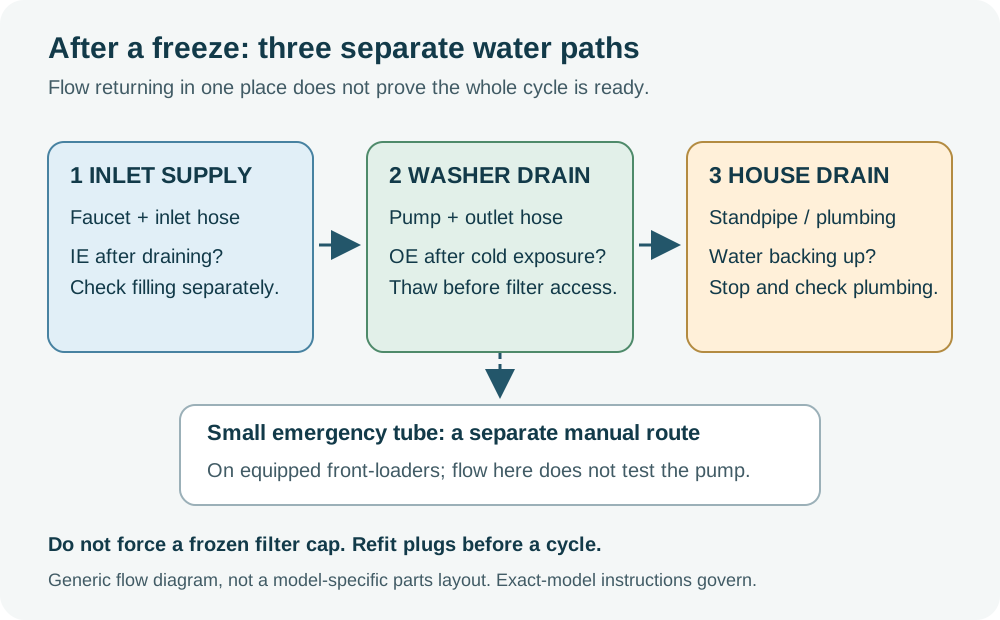
This guide covers the cold-weather branch for full-size LG washers. A front-loader with a small emergency drain tube needs different handling from a top-loader. Use the instructions for your exact model; Mini Washer and SideKick controls are outside this guide.
Before turning a stiff filter cap
Cold weather can freeze water inside a hose or pump area. Opening the drain filter while the washer is still partly frozen can detach its handle. A cap that resists turning is a reason to stop, not to reach for a longer tool.
Turn the washer off and unplug it before the manual draining or hose work below. Let hot wash water cool before handling it. Do not use boiling water, force a locked door, or keep adding water to a full drum. Stop if water is leaking, a fitting is damaged, or electricity and water could come into contact.
If the handle has already come off, leave the washer off and ask LG about the filter assembly. Do not run the washer with a damaged or unsecured cap.
Front-loader: thaw first, then use the small drain tube
For models covered by LG's front-load thawing guidance, open the door only when it releases normally and remove the laundry. The documented method uses 50–60°C (122–140°F) water in the drum, left for one to two hours. Follow the model guide for the amount; there is no single bucket quantity that fits every washer. If existing water prevents safe access or adding the specified amount, get assistance instead of forcing this step.
Once the water has cooled enough to handle, use the small residual-water drain tube as the manual directs, with towels and a shallow container ready. Keep the main filter cap closed until the water has drained. Refit the tube plug securely afterward.
If a washer known to be frozen still releases no water through that tube, allow more thawing time rather than forcing the filter. This is a cold-weather decision, not a universal explanation for a dry tube: LG also documents a kinked residual hose after it has been pulled out too far. If the washer has warmed fully and the tube still gives no flow, return to the model's drain troubleshooting or contact service.
After the thawing and draining procedure, restore all plugs and caps and use the model's rinse check. Watch both water entry and discharge. Stop if it leaks.
Top-loader: do not borrow the front-loader filter steps
LG's top-load frozen-water guidance also uses 50–60°C water and an initial one-to-two-hour wait, but notes that thawing may take longer than two hours, depending on conditions. Follow that guide only when it applies to your model and the tub can be accessed safely.
For an externally frozen drain hose, the same guidance describes wrapping the hose with a warm towel. After thawing, use the model's Spin Only function to check drainage. Once draining works, run Rinse+Spin to check water supply and discharge together. Button combinations vary; a top-loader does not automatically have the front service filter and small tube shown in front-load instructions.
The water drains now, but IE appears
That change matters. OE concerns drainage; IE concerns filling. Warming the drum or clearing the outlet does not establish that the faucet and inlet hose are ready to supply water.
Check that the water supply is available and the inlet hoses are not kinked. If freezing is suspected there too, LG's front-load supply guidance describes a warm towel around a frozen faucet for about five minutes. Shut the faucet before disconnecting an inlet hose. A disconnected frozen supply hose can be thawed in warm water below 50°C (122°F) under that guidance.
Do not confuse the two temperatures: the drum-thaw method specifies 50–60°C; the disconnected inlet-hose soak specifies below 50°C. Reconnect hoses to the correct hot and cold connections and check for leaks before the prescribed rinse test. If the supply remains unavailable, address that supply problem before trying another wash.
A household drain is a third possible blockage. If water backs up at the standpipe or sink, stop the washer and have the building drain checked. Repeated rinse tests will not clear a blocked household outlet.
What partial improvement can hide
Two cold-weather owner reports show why one successful step is not a complete diagnosis. These are individual experiences, not LG repair instructions.
- An unheated-basement washer, brand not identified: the owner described filling and agitation but no draining during severe cold. Pouring hot water down a hose had not restored operation. After warming the area for about three hours, the owner reported water flowing out and normal operation. That report does not establish which internal part had frozen, or make three hours a universal thawing time.
- GE GTW335ASN1WW, not an LG model: after an initial thawing attempt, the owner reported that hot water entered and the pump could empty the tub, while cold-water filling still failed. After further warming, the owner reported recovery and attributed it to remaining ice around the cold inlet and motor area. Those locations were the owner's explanation, not an independently confirmed diagnosis. The useful distinction is that successful draining did not settle the separate filling problem.
Two LG reports provide a different limit: apparent drainage trouble should not automatically be blamed on freezing.
- LG WM4370HKA: the owner had replaced a pump, pressure sensor and control board and cleaned hoses, yet still reported OE. The small manual drain tube emptied the washer, but powered draining remained faulty. No cold-weather cause or final repair was established. Water leaving through the small tube did not prove the normal drain cycle worked.
- An LG front-loader, exact model not supplied: an owner reported OE and leakage near the front drain filter. Removing the small drain-tube plug allowed the cycle to continue but did not resolve the leak; the owner later reported normal operation after a pump replacement. That sequence does not justify leaving a drain plug open or prescribing a pump for another washer. A leak is a stop condition.
Do not reproduce internal repairs, electrical tests or makeshift draining from these accounts. Their value is in separating what changed from what remained unresolved.
When the thawing branch is finished
If the washer and exposed hoses have warmed fully, all plugs and connections are secure, and OE still returns, use the general washer drain checks or arrange service. If the tub is empty but the machine will not spin, use the washer spin guide. Repeating warm-water treatments is not a substitute for investigating a persistent fault.
For the service call, record where the washer was exposed to cold, which water path now works, whether the next message is OE or IE, and whether any cap or hose connection leaks. Avoid guessing a failed part from a hum or one brief discharge.
To prevent another freeze, follow the model's cold-weather storage and residual-water draining instructions. A completed wash does not mean every hose is dry. If the installation stays below freezing, address the location before returning the washer to regular use.