An oven can smoke because of old grease, a fresh spill, cleaner residue or the way fat drains from the food. Turn it off before investigating and let it cool. If there are flames, keep the door closed; if smoke is heavy or you cannot safely control the situation, leave and call 911 from outside. A burning electrical smell or smoke that returns after cleaning needs service.
This guide covers household ranges and wall ovens. Air Fry, +Grill and AquaLift instructions below apply only to ovens equipped with those features. Countertop air fryers and microwave combination ovens need their own manuals.
First, rule out an emergency
For a fire inside the oven, turn off the heat only if you can reach the controls safely, and keep the door shut. Do not pull out a burning pan or throw water on burning grease. If you are unsure whether the fire is out or it is safe to remain, get everyone outside and call 911.
If you smell gas, leave without operating electrical switches, including the exhaust fan. Call your gas supplier or emergency service from outside. Do not keep trying to light the oven to identify the problem.
When the situation is safe and the oven is completely cool, work through the branch that matches what happened.
It started during the first uses of a new oven
Some new ovens produce odor or a little smoke during their prescribed first-use cycle. Check the cavity and accessories for packaging and tape before following that cycle in the owner's manual. Use the specified mode, temperature and duration, with the ventilation the manual requires.
Do not extend this into repeated high-temperature runs until an unexplained smell disappears. If the prescribed preparation is complete and smoke remains heavy, comes from the casing, or accompanies melting or damage, stop and contact the manufacturer.
It smokes before the food goes in
Old drippings can heat up during preheating. Once the oven is cold, look at the cavity floor, accessible walls and removable cooking trays. A clean baking sheet does not tell you whether yesterday's spill is still on the oven floor.
Remove loose food and clean accessible surfaces using the method approved for the oven's finish. Do not remove a hidden-element cover, open the cabinet or spray liquid into openings to chase an unseen deposit. Persistent smoke with no accessible residue belongs in the service branch below.
If the problem began immediately after cleaning, check the cleaning product's removal instructions as well as the oven manual. Residual cleaner needs to be removed; a generic instruction to “burn it off” is not a substitute. Avoid adding a second chemical cleaner to the first.
Also check for foil or an aftermarket liner on the cavity floor. Remove it when cold, and keep oven vents clear. A tray on a permitted rack and a sheet lining the oven floor are different arrangements.
It happens while broiling fatty food
Check both the distance from the heat and where the drippings go. Use the rack position specified for the food in your manual. Moving food closer to the upper element can scorch the outside quickly.
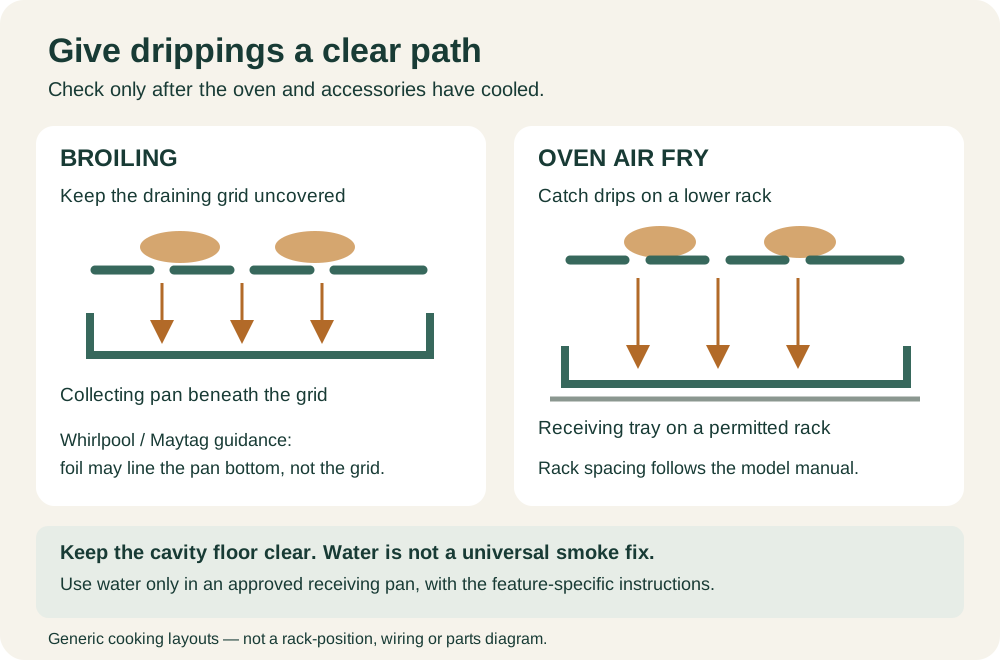
For Whirlpool and Maytag ovens covered by their broiling guidance, use a broiler pan with its draining grid. Keep the grid openings uncovered: foil stretched across the grid prevents the juices from draining into the pan beneath. Their guidance permits foil in the bottom of the collecting pan, not over the grid.
Trim excess fat before cooking and clean the pan after use. Correcting the rack position will not fix a grid that is holding hot grease against the food.
It happens in Air Fry or with a grill attachment
The receiving pan matters. These are separate manufacturer-approved arrangements; do not pour water onto the cavity floor, an element or hot grease to stop active smoke.
| Oven feature | Setup to check before the next cooking session |
|---|---|
| Samsung oven with Air Fry | Put a baking sheet or tray on the rack below the Air Fry tray to catch drippings. Samsung's guidance also allows some water in that receiving sheet to reduce smoking. Confirm the rack layout in your model's manual. |
| Whirlpool wall oven with +Powered / +Grill attachments | After everything cools, remove and clean the grill attachment and base pan. Whirlpool specifies 1 cup (240 mL) of water in the base pan when grilling greasy foods. This amount belongs to that attachment, not every oven drip tray. |
If your oven's manual does not authorize water in a receiving pan, do not borrow that step from another brand.
For LG ranges covered by LG Canada's Air Fry smoking guidance, fresh fatty chicken can produce too much smoke in Air Fry. The suggested alternative is a broiler pan and grid in Convection Roast, instead of the Air Fry tray and mode. Stop the smoky cook safely first; use this alternative only where your model's manual supports it. Changing modes does not make an oven with electrical symptoms safe to use.
After cooking, clean the accessories as well as the cavity. Samsung's Air Fry tray can be washed with lukewarm soapy water and a plastic scouring pad, or in a dishwasher. Remove it before Self Clean: that cycle's heat can damage the coating. Do not leave it inside as a shortcut to washing it.
It smokes during or after a cleaning cycle
A high-temperature Self Clean cycle burns soil off the cavity, so a little smoke can occur. Large grease spills should be removed beforehand using the manual's preparation instructions.
For excessive smoke during Self Clean, cancel the cycle and allow the oven to cool and unlock. GE's range and wall-oven guidance uses Clear/Off or Cancel/Off and requires cooling before the door can release. Do not force the latch. Once cold, remove the excess grease or soil before considering another approved cleaning cycle. Flames or an unsafe amount of smoke still require the emergency response above.
AquaLift needs a different follow-up. On Maytag ovens equipped with AquaLift, a completed cycle can leave water and loosened soil for you to remove. Use the approved nonabrasive cleanup method; stubborn soil may need another AquaLift cycle. Do not add chemical oven cleaner to make that cycle stronger. Use the water amount and instructions for your exact model.
A finished cleaning cycle is not proof that every smoking deposit has been removed. If cleaning is complete but the oven now fails to heat, use the separate guide to an oven not heating after self-cleaning.
It still smokes after those checks
Leave the oven off and arrange service if smoke returns after approved cleaning, comes from behind the controls or casing, or is accompanied by a pop, sparking, a tripped breaker or visible damage. Do not run it again just to film the symptom. For an electric oven, switch off its identified circuit breaker if safely accessible. With any gas smell, leave first.
Give the technician the model number and the sequence you already observed: the cooking mode, whether food was present, where smoke first appeared, and what cleaning or repair had already been tried. Include whether the problem changed afterward. Those details are more useful than guessing a failed part from smoke color.
If the actual problem is continued heating after Cancel, see oven won't turn off. Smoke by itself does not establish a thermostat, element or control-board diagnosis.
Official references
- Whirlpool: oven smoke causes and broiler pan and grid use
- Samsung: Air Fry setup and tray care
- Whirlpool: +Powered attachment smoke
- LG Canada: Air Fry smoking
- GE: smoke during Self Clean and Maytag: soil remaining after AquaLift
- Texas State Fire Marshal: cooking fire response and Maytag: gas-odor response