If your oven will not heat after self-cleaning, first check whether it is still cooling, showing a fault code, or fully cool but unable to cook. A locked door or a working clock does not identify a failed fuse. Let the oven cool, read the exact message, and use the recovery instructions for your model before arranging service.
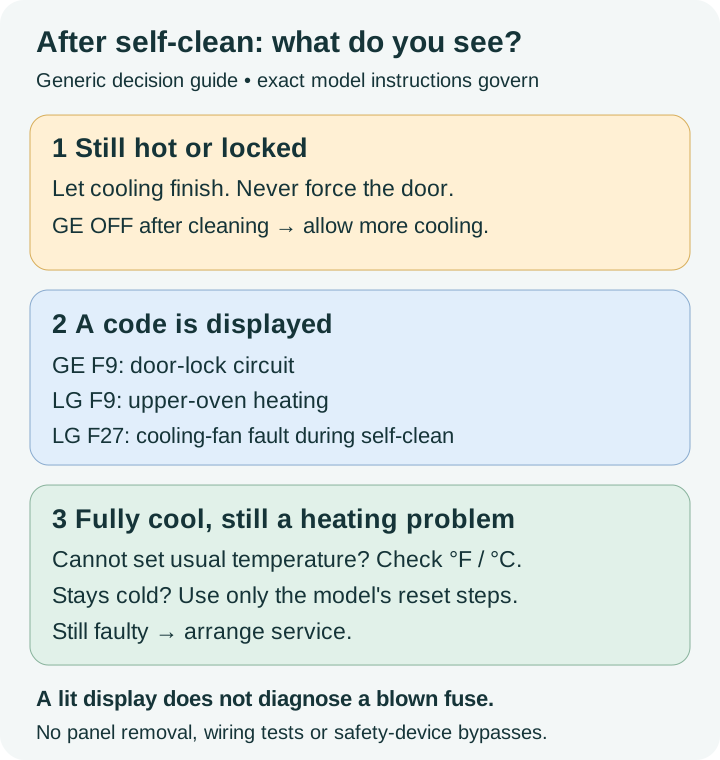
This guide concerns trouble following a high-heat self-clean cycle. Steam-clean and catalytic-clean systems work differently. The brand-specific branches below are not interchangeable, and an electric-oven repair does not diagnose a gas oven.
Still hot or locked: let cooling finish
The door may stay locked after cleaning heat stops. Do not pull hard on the handle or try to release the latch with a tool. Whirlpool's applicable locked-door guidance allows approximately 30–90 minutes for cooling; that is an example, not a deadline for every oven.
On a fully cooled oven, use the model's Cancel/Off or latch-reset instructions. If it still will not release normally, stop and arrange service.
GE shows OFF when you select Bake or Broil
On GE models covered by its fault-code guide, OFF shortly after self-cleaning can mean the oven needs more cooling time. Let it cool longer, then retry cooking. That message in this context does not establish that a heating element has failed.
A power cut interrupted a Whirlpool cleaning cycle
If power failed during self-clean and the cycle did not resume, Whirlpool gives a specific recovery sequence: select Self Clean, then Cancel, wait a couple of minutes, and try starting the cycle again. Check that this guidance applies to your model before using it.
This is recovery from an interrupted cleaning cycle, not a general treatment for an oven that completed cleaning and now stays cold. If there is an error, abnormal behavior or a recurring problem, stop instead of running repeated cleaning cycles.
A code is showing: the brand changes the meaning
Write down the complete code before clearing it. These examples come from the brands' applicable fault-code guides; your exact model's manual takes priority.
- GE F9: a problem in the door-lock circuit; it does not identify one specific failed part. Follow the model's fault recovery guidance and arrange service if it returns. Do not force the door.
- LG F9: the upper oven is not heating properly. Press Clear/Off and retry the original function. If it returns, LG specifies a 30-second breaker reset; persistent or unresettable errors need service.
- LG F27: a cooling fan stalled or locked during self-clean. LG specifies a 30-second breaker reset. If the code persists, arrange service.
LG F9 is not GE's door-lock diagnosis. LG's same code list identifies F10 as an upper-oven door-lock problem. Match the code to the brand and model before ordering anything.
F27 also needs more attention than simply hearing a fan after cleaning. It is a reported cooling-fan fault in that self-clean context. Do not restart high-heat cleaning to see whether the fan recovers.
It heats, but will not accept your usual temperature
Check the temperature units before looking for a sensor reset. On many GE ranges and wall ovens, a setting that will not go above 290, or an ERR response when entering a higher setting, can indicate Celsius mode. Use your model's Fahrenheit/Celsius setting instructions; button combinations vary.
One owner, whose model was not supplied, reported a temperature limit after self-cleaning. Searching inside for a reset button had not helped. After changing the temperature-unit setting, the owner reported that the main problem was resolved; an older clock problem remained. The reported numbers were inconsistent, so they are not a diagnostic threshold.
That individual sequence does not prove self-clean automatically changes temperature units. This branch applies to a setting-limit problem, not an oven that stays completely cold. Leave panels in place.
Fully cool, no useful heat: one reset has limits
Use only the accessible power-reset procedure specified for your appliance. For example, Wolf's electric-oven guidance calls for switching the breaker off for 30 seconds. If the oven still does not heat afterward, including when its fans run, it directs the owner to service.
A successful display restart is not proof of successful heating. Record whether the oven stays cold, produces heat briefly, or returns to the clock. A working panel does not establish that the heating circuit is healthy; neither “both Bake and Broil are cold” nor “the light works” proves a blown fuse.
A power reset is also different from resetting an internal thermal switch. Some electric wall ovens have a resettable thermal switch, while others use different protection. Access may require removing the oven and panels. Leave that work to a qualified technician; do not search behind the oven, bridge a safety device or test live terminals.
What happened after the first attempt failed
These owner-reported histories show why the next step should depend on what actually happened. They are not repair instructions or proof of the fault in your oven.
- GE PTD7000SN3SS: after the lower oven's self-clean cycle, the owner reported a dead display and locked lower door. Cycling the breaker did not help. One technician proposed a board replacement; a second technician reportedly tested and replaced a fuse, restoring operation. The first proposed repair was not reported as having been performed.
- Whirlpool GFE461LVS: the owner reported no heat after self-clean and no improvement after disconnecting and reconnecting power. The clock worked, and the owner later said the fuse was not the problem. A control-board fault was proposed, but no completed repair was confirmed. That report cannot establish that a board was needed.
- GE JKP17: replacing a heat-limit component did not resolve the post-cleaning failure. The owner then reported brief heat on Broil followed by a return to the clock; Bake also exited instead of continuing to heat. A board or relay problem was suggested, but the final repair was not reported. “Heats briefly, then cancels” is useful service information that would be lost in a simple “no heat” description.
Together with the temperature-unit case above, these accounts have different outcomes: two reported improvements and two unresolved repairs. None establishes how often self-clean damages a particular part.
When to stop and what to report
Stop using an oven with an electrical burning smell, visible scorching or a repeatedly tripping breaker. For a gas smell, leave the area and contact your gas emergency service from a safe location; do not operate switches or keep trying to ignite the oven.
Once the oven is cool and the applicable owner checks have failed, a technician may need to investigate the lock circuit, thermal protection, supply, wiring or controls. A fuse diagnosis should include why protection opened, not just a replacement based on timing.
For the appointment, give the model number, the code exactly as displayed, and whether cleaning completed or lost power. On a double oven, identify the affected cavity. Include the result of the permitted reset and whether heating never starts or starts and then stops. Do not repeat self-clean as a repair test.
If there was no cleaning-related onset, the general oven-not-heating guide covers mode, fuel and heating-pattern checks.