If your oven keeps heating after the correct Off or Cancel command, stop using it. For an electric oven, switch off its identified circuit breaker if you can do so safely, and leave it off for service. If you smell gas, leave without operating electrical switches and call your gas supplier or emergency service from outside. A fan running while the oven cools is a different situation: check which function is still on before treating it as uncontrolled heat.
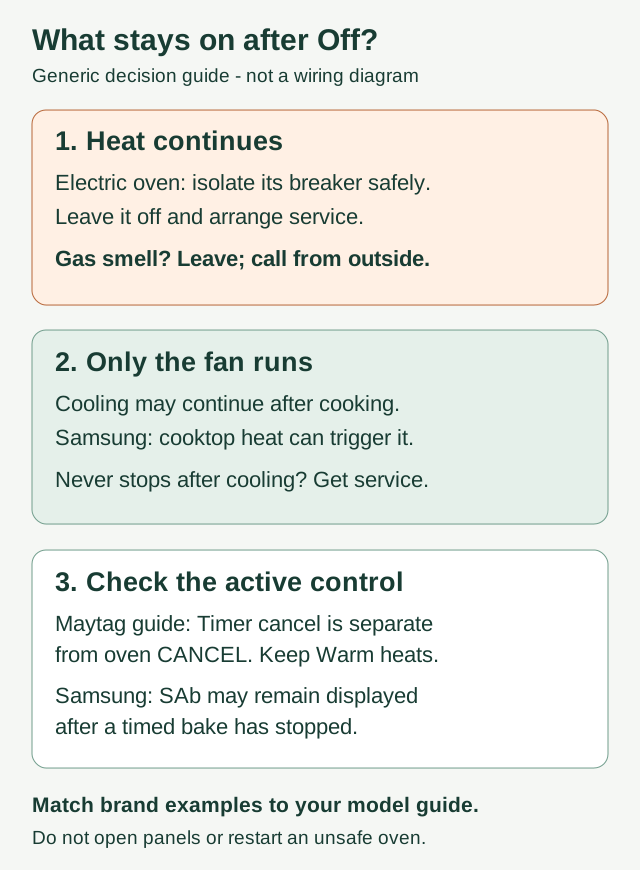
This guide covers household ranges and wall ovens. It does not cover countertop toaster ovens or microwave ovens. On a dual-fuel range, the oven and cooktop use different fuels; identify the affected part.
Is it still heating, or just still warm?
A hot cavity takes time to cool. Warm glass, warm air at a vent, a light or a fan does not by itself prove the oven is still producing heat.
The concerning pattern is continued heating after the cooking function has been canceled: an element keeps glowing, a gas burner keeps firing, or the oven continues heating instead of cooling. Do not touch the element or reach into the cavity to test it. Do not turn a suspect oven back on to reproduce the problem.
For a gas oven that will not stop heating, do not assume cutting electrical power has made the gas supply safe. If there is no gas odor and the appliance shutoff valve is already safely accessible, close it; do not move a hot range or reach behind it. If you cannot safely stop it, get urgent help from your gas supplier or emergency service. With a gas smell, leave first and make the call outside.
Only the fan is running
Many ovens have a cooling fan for the controls as well as a convection fan that moves air around the food. They do different jobs, and not every model has both.
GE's range and wall-oven guidance allows cooling-fan operation for about 15 minutes to two hours, depending on how hot the oven became. That is a GE example, not a two-hour rule for every brand. A generic claim that any fan running beyond 30 minutes is defective can send you toward an unnecessary repair.
Samsung: the cooktop can start the cooling fan too
On the Samsung ovens covered by its fan guidance, heat from either the oven or the cooktop can start the internal cooling fan. It stops when the electronics cool. So “I did not use the oven” does not rule out normal cooling after using the range's surface burners.
The visible convection fan at the back of the cavity is separate. Samsung describes it cycling during convection cooking; on applicable electric ovens it also runs during preheat without a convection setting. Those behaviors should not be confused with a cooling fan stuck on.
If the fan never stops after the appliance has cooled, or it makes a new grinding or squealing noise, arrange service. Do not shut off power merely to silence otherwise normal cooling, and do not open panels to find the fan.
The timer stopped, but cooking did not
Look at the exact key you pressed. An alarm timer and the cooking function can have separate cancellation controls.
For example, the Maytag Freestanding Gas Range Control Guide W11728799 RevA distinguishes Timer Set–Cancel from CANCEL. The first cancels the timer; the second stops the oven function. Clearing an alarm or returning to the clock therefore does not necessarily cancel cooking.
Use the oven's actual Off/Cancel control, following your model's guide. If heat continues despite that command, use the stop-use branch above rather than repeatedly pressing buttons.
Keep Warm is still a heating function
The same Maytag guide treats Keep Warm as an active mode and directs the user to press CANCEL when finished. A low-temperature holding mode is not the same as an oven that has been switched off. Check the selected mode before assuming a stuck relay; if Cancel does not stop it, do not leave it running.
Match these controls to your own guide.
Samsung SAb stays on the display
On Samsung models with the documented Sabbath feature, the display can stay at SAb and remain quiet even when controls are used. The light can also retain its previous state. Neither indication alone tells you that heating is still on.
Samsung distinguishes stopping the oven from leaving Sabbath mode. A Cook Time set before entering the mode can expire and stop the heat while Sabbath mode remains enabled. Follow your exact model's instructions to cancel cooking and, separately, exit Sabbath mode. Button combinations vary; do not borrow one from an unrelated model.
Do not wait for an assumed automatic shutoff to solve an oven that is actively ignoring Off. The mode is designed to change normal operation, and an actual shutdown failure still needs isolation and service.
A knob or cleaning cycle will not stop
On a mechanical control, check that you are using the oven control and that its pointer actually reaches Off. A loose, slipping or jammed knob can make the selected setting unclear. Do not force it, remove hot controls or keep turning it back and forth while heat continues.
During self-cleaning, use the model's documented cancellation control. On the Maytag guide above, CANCEL stops the cycle, but the door stays locked until cooling finishes. A locked door is not proof that cleaning heat is still on. Never force the latch. If the later problem is failure to heat after cleaning, use the separate post-self-clean heating guide.
When the first attempt did not solve it
These reported histories show why “still on” needs a precise description. They are individual accounts, not tests of your oven or instructions to copy internal repairs.
- Electric oven, model not supplied: the owner turned the dial off, then disconnected power and let the oven cool. Reconnecting power brought the lower element's heat back immediately. The owner subsequently reported visible element damage and ordered a replacement; a successful repair was not confirmed. Cooling during a power cut had not established that the fault was gone.
- Samsung NE58R9431SS: a breaker reset stopped the unwanted fan briefly, but it returned while the range was unused. Several replacement parts did not settle the problem. The old parts were put back, and the owner later reported that the fan stopped behaving that way. The cause remained unresolved; this is not evidence for a particular replacement part.
- GE Café CES750P4M2W2: after a storm, the owner described the fan, lights and app status staying on, while ordinary heating still worked. Replacing boards and the display did not resolve it. A later switch-assembly and harness replacement reportedly did. That sequence concerns a reported control/fan fault, not proof of a runaway heating element.
- Viking VGIC5304BAR: a repair report described gas bake continuing after Off. A solenoid swap, an ignition-board replacement and then a thermostat replacement failed to resolve it; a later follow-up implicated the gas valve. Gas-system diagnosis belongs to a qualified technician. This report does not make any one of those parts the default answer for another oven.
What the technician needs to distinguish
Possible causes of genuine continuing heat include a stuck control relay, a shorted electric element, a failed mechanical thermostat or selector, and damaged wiring. The symptom alone does not identify which one failed. A new board is not proof that the rest of the circuit is healthy.
Leave panels, wiring, relay tests and gas components to the technician. Report the model and fuel type, the affected cavity on a double oven, and what actually remained on: heat, fan, light or display. Include the selected mode, the control you used to cancel it, and any reset or repair already attempted. Existing observations are enough; do not recreate an unsafe fault to collect more details.
If the oven shuts down normally but cannot produce useful heat, the oven-not-heating guide covers that separate problem.