A dishwasher that fills with water while it is off may be admitting supply water through its inlet valve or receiving water back through the drain connection. Close its water supply if the level is rising, and stop using it until the cause is checked. First distinguish water actually entering the tub from a pump running on its own: some Samsung leak warnings deliberately start draining even when you have not selected a cycle.
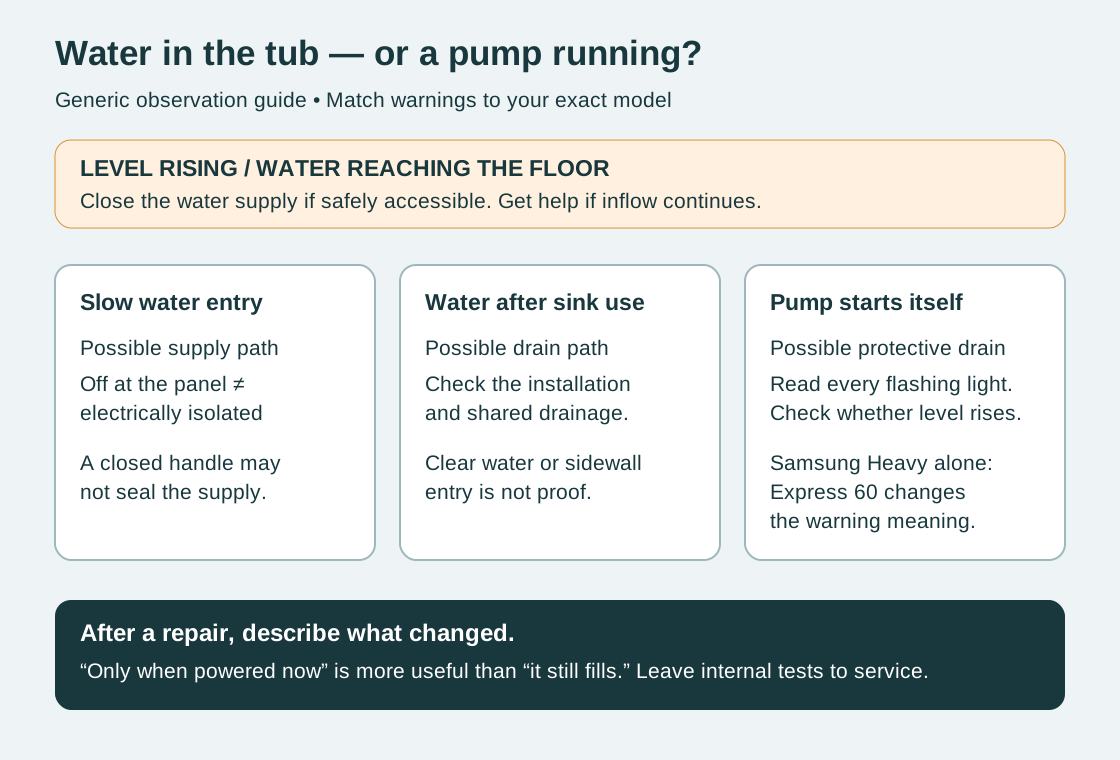
Stop a rising water level first
If water is approaching the door or reaching the floor, do not leave the dishwasher filling while you try resets. Close the appliance's accessible water shutoff. If it does not stop the inflow, get urgent plumbing help to isolate the supply. Keep away from wet plugs and wiring; disconnect electrical power only from a dry, safely accessible point. Do not pull the machine out or remove its panels to reach a valve.
A quiet control panel is not protection against a leaking water valve. Equally, an automatic drain pump is not a substitute for stopping an uncontrolled water supply.
Was it empty after the last drain?
A little water confined to the filter well can be normal on some dishwashers. A pool spreading across the tub, or a level that keeps increasing between uses, is a different observation. Check the normal residual-water description in your own manual instead of borrowing another model's water depth.
The useful distinction is water that never left versus water that left and came back. If the tub stays full immediately after a drain attempt, start with the dishwasher not draining guide. If it empties and later refills, note what happened between those two observations.
| What you already observed | What it helps distinguish |
|---|---|
| Water returns when the sink or another connected appliance drains | A shared-drain or backflow problem needs attention. |
| Water creeps in while the sink is unused | Supply-side seepage becomes a possibility; appearance alone cannot confirm it. |
| The machine makes a pumping sound but the tub level does not rise | Check its warning lights and automatic-drain behavior before calling it a filling fault. |
| A repair changed when water enters | Give the technician the before-and-after sequence, not just “it still fills.” |
Do not deliberately flood the sink or leave the dishwasher unattended to recreate the symptom.
“Off” needs a more precise description
Tell the repairer whether you pressed Power, ended a cycle, or actually disconnected the electrical supply. Those are different states. A valve that fails to seal can pass water without electricity; unwanted electrical operation requires a different investigation.
If you already noticed that entry stopped when electrical power was disconnected, record that fact. It does not identify a control board, sensor or valve by itself. Do not reconnect power to a flooding machine just to repeat the test.
Clear water is another imperfect clue. Water returning from a recently used sink need not look dirty. Odor and food residue can support a backflow suspicion, but clean-looking water does not settle the route.
A closed shutoff handle is not proof that the supply stopped
The valve under the sink and the dishwasher's inlet valve are separate parts. An old household shutoff may fail to seal even with its handle in the closed position. Continued filling after turning that handle therefore does not automatically prove drain backflow.
If closing the supply only slows the entry, tell the plumber exactly that. Do not force a stiff handle or disconnect a pressurized hose to check it. Have the shutoff's ability to isolate the appliance confirmed before treating that observation as a diagnostic result.
Water from a side opening can still need a drain investigation
The visible entry point can be misleading. In one Samsung installation, a high loop was already present, yet sink water was reported entering through the dishwasher's sidewall case-break area. The owner traced it from the sink and later reported that changing the drain connection resolved the backfill.
That is one installation history, not a plumbing layout to copy. Its useful lesson is narrower: “I saw it at the side” does not, by itself, establish that fresh supply water crossed the inlet valve. Give an installer a photo of the existing drain connection and describe when the water appears.
For Samsung installations, the drain arrangement must follow the model's instructions and applicable local requirements. A blocked sink or disposal, a pinched hose, or an incorrect connection can interfere with drainage. A visible high loop alone does not prove that the whole installation is correct. Have shared-drain problems checked by a plumber; leave appliance valve and control diagnosis to service.
Samsung: a pump that starts by itself may be responding to moisture
On applicable Samsung dishwashers, a leak-sensor warning can turn the machine on and keep it attempting to drain. That behavior can make the Power button seem ineffective. It is not evidence, by itself, that the machine is commanding fresh water into the tub.
For a Heavy light flashing on its own, the panel matters:
| Samsung panel | Meaning of Heavy alone | Next step |
|---|---|---|
| No Express 60 cycle | The leak sensor detects moisture; the machine may start itself and keep attempting to drain. | Request service for the leak warning. |
| Has Express 60 | Too much water in the dishwasher. | Follow the model's drain/overflow guidance and address continuing inflow. |
Do not apply these rows when several lights flash together. Photograph the complete pattern. If the water level is rising, deal with the water supply first; do not keep resetting the warning.
GE Monogram ZBD3500: the door matters during automatic draining
The older ZBD3500 has a specific response to its too-much-water warning: it pumps out excess water while the door is latched. Its manual directs the owner to wait until the motor stops before opening the door to check the tub.
If water is still entering, the specified response is to close and latch the door and shut off the dishwasher's water supply. A repeated warning calls for water shutoff and service. This sequence is specific to ZBD3500; it is not a reason to keep an unidentified, flooding dishwasher powered or to open its door repeatedly while it is draining.
If a new inlet valve changed the symptom, report the change
“Still fills” can hide two different faults. One Samsung DW80M2031US owner described a slow leak while off, then a different problem after valve replacement: the old leak stopped, but water entered as soon as electrical power was restored, before a program started. Reinstalling the old valve brought back the old leak while the powered-filling problem remained. The owner later reported a control-board repair resolved the powered behavior.
That report does not establish a board failure in your machine. It shows why the changed condition matters. Ask the repairer to compare the original and current power states and recheck the previous work before ordering the same part again. Leave electrical measurements and internal repairs to a qualified technician.
What to tell the repairer
A useful description is short: full model number, exact lights or display message, whether the tub emptied first, what other plumbing was in use, and what changed when water or electrical power was shut off. Add any recent repair and whether it changed the symptom.
Until a rising level or repeat refill has been resolved, keep the dishwasher out of use and its water supply isolated. Repeated draining clears the tub temporarily; it does not establish that the entry path has been fixed.