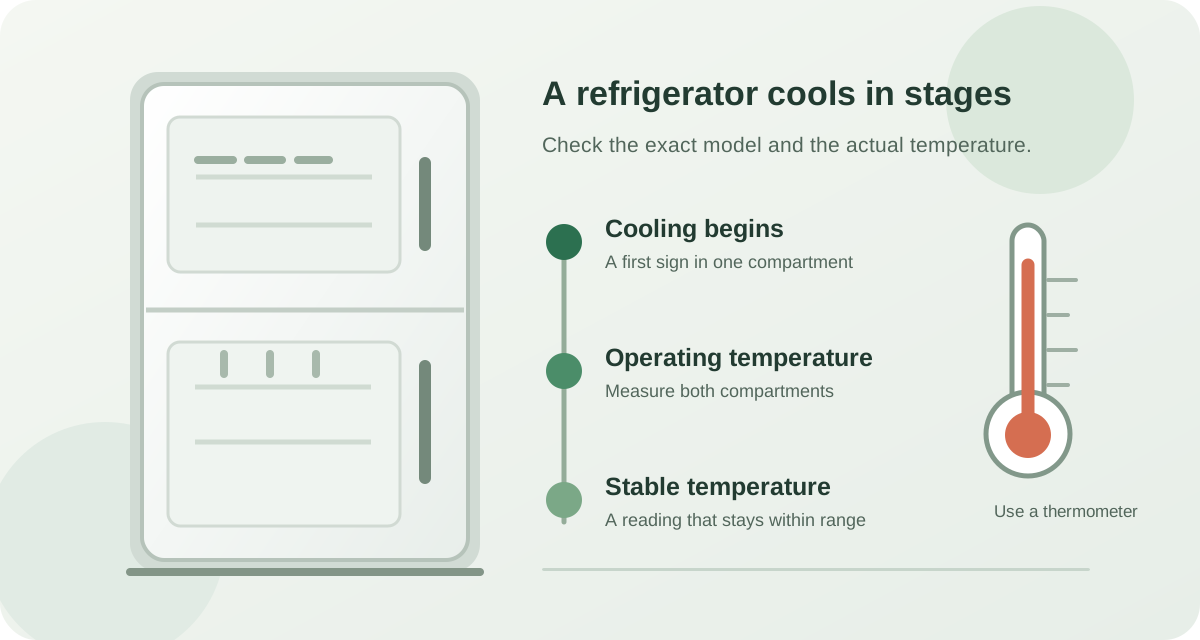
A new refrigerator can take hours to cool after installation, but there is no single wait time that applies to every model. Use the instructions for your exact model, then check whether the measured temperature is moving down. “Cooling has started,” “safe to store perishables,” and “the whole refrigerator has stabilized” are different checkpoints.
If food needs refrigeration now, keep it in an already-cold refrigerator or a properly iced cooler until the new unit is verified at 40°F or below. A display setting is not a thermometer reading.
Start with the temperature trend
Write down when the refrigerator was plugged in and the time shown on its display. Check the refrigerator and freezer separately. If you have appliance thermometers, use them; the set temperature on the panel describes the target, not necessarily the current temperature of the food.
For a steadier fresh-food reading, the USDA Food Safety and Inspection Service advises placing an appliance thermometer in a glass of water in the middle of the refrigerator and checking it after 5 to 8 hours. Avoid opening the doors just to check the reading over and over. If your exact model gives a different measurement method, follow its manual.
The direction matters. A reading that falls and then rises after the doors are opened or groceries are added needs another check. A reading that does not move at all is a different signal. Neither one identifies a failed part.
Why the published wait times do not match
Some instructions describe when to begin storing food. Others describe the first sign of cooling, normal operating temperature, or full stabilization. Those are not interchangeable promises.
| Example guidance | What the time refers to | What to do with it |
|---|---|---|
| Samsung refrigerators: wait 2 hours after plugging in to make sure the refrigerator is cooling before storing food | An initial check before storage | Use only for the matching model family, and still verify that perishable food will be held at 40°F or below |
| GE refrigerators: some freezer cooling should be apparent in about 1 hour; allow up to 24 hours to stabilize | An early freezer sign, followed by full stabilization | Check both compartments; the first sign in the freezer is not proof that the refrigerator section is ready for food |
| Typical Whirlpool refrigerators: about 8–12 hours to reach operating temperatures and up to 24 hours to fully stabilize | A typical operating-temperature window and a longer stabilization window | Room temperature, starting temperature, model layout, door openings, and contents can change the time |
| Frigidaire guidance for a newly installed unit: allow 24 hours for temperature stabilization | A model-family stabilization allowance | If the unit is still not cooling, use its installation instructions and contact the installer or support |
These figures do not create a universal countdown. Do not average them, and do not assume that a two-hour check means every compartment has already reached a safe food temperature.
Four checks that help separate a slow start from a problem
- Confirm first power-on and the display. Make sure the refrigerator is plugged in and note any displayed mode, code, or blank control. If the display suggests showroom or cooling-off mode, use only the matching manual to identify it; do not guess at button combinations.
- Record both compartment readings. A freezer that starts cooling while the fresh-food section remains warmer is useful information, but it does not by itself prove that either section is working normally. Record the time and temperature for each.
- Keep the setup simple. Check that packaging or a shelf is not blocking an interior vent, and that the doors close. If groceries are added, note when and how much; a large warm load can extend pull-down time. Do not change several controls at once.
- Use the model’s service window. If there is no measurable cooling within the time specified for the exact refrigerator, contact the installer or manufacturer. GE’s initial-installation guidance recommends service if there is no sign of cooling within the first 24 hours. Do not remove panels or test internal parts on a new appliance.
Temperature snapshots can tell different stories
A new GE bottom-freezer refrigerator was still at 75°F after 24 hours. After it was unplugged and run for another 24 hours, it still had not cooled and airflow stopped. A replacement refrigerator was then allowed to sit for 4 hours before it was plugged in; its temperature was dropping after about 2 hours of operation. That sequence does not prove the waiting period repaired anything. It shows why a persistently warm first unit should not automatically be explained away as a normal startup delay.
Another pattern looks less straightforward. A Whirlpool WRFZ767SDHZ was at 34°F after 30 hours. After groceries were loaded, three later readings were 44.9°F, 49.1°F, and 47°F about 8 hours later. A temperature increase after loading is a reason to recheck the trend and protect perishable food; those readings alone cannot tell you whether the refrigerator is defective.
On a new LG LRMWS2906S, two thermometers stayed at or above 40°F. The temperature reached 40°F after 6 hours, then read 43°F two hours later. The first unit was exchanged for the same model, but the second showed a similar pattern. A single lower reading can be misleading if the temperature does not stay down.
One new GE Profile French-door refrigerator stayed near 41°F with the control set to 36°F while its freezer stayed at 0°F. The doors had remained shut overnight and the vents were clear; service was arranged. A working freezer does not establish that the refrigerator compartment is cold enough.
These are different observations, not a set of diagnoses. Use the pattern to decide what to report: time since first power-on, both compartment temperatures, whether either number is changing, and whether the doors were opened or groceries were added.
What the clues can and cannot tell you
| What you notice | What it may tell you | What it cannot prove | Next step |
|---|---|---|---|
| The display shows the target temperature | The control has a target setting | That the food compartment is already at that temperature | Measure the compartment with an appliance thermometer |
| The freezer begins cooling first | At least one compartment is showing a cooling change | That the fresh-food section is ready or that the appliance is fully stable | Keep separate time-and-temperature notes for both sections |
| The temperature falls, then rises after loading | The new load or door activity may have changed the recovery pattern | That a specific part has failed | Recheck after the doors stay closed; keep perishables in a verified cold place |
| No temperature drop appears within the exact model’s stated window | The normal installation allowance may have passed | Which internal component is responsible | Contact the installer or manufacturer while the appliance is new |
If a food thermometer shows perishable food above 40°F for more than 2 hours, follow the USDA’s food-safety guidance rather than relying on smell or appearance. See the food-safety check in the main refrigerator guide.
When to stop waiting and contact the installer
Contact the installer or manufacturer if the measured temperature does not fall within your model’s stated startup window, a control error remains after you follow the manual, or one compartment remains warm while the other cools. Tell them the full model number, the time of first power-on, the temperature readings and times, and whether the refrigerator was moved or tilted during delivery.
For a Frigidaire unit, its support instructions direct refrigerators installed within the past 30 days back to the installer; units installed longer ago are directed to its service scheduling path. Other brands may use different service routes. If the refrigerator was laid on its side or moved before installation, use the separate post-move cooling guide because transport position changes the question.
FAQ
Should I wait 2 hours or 24 hours?
Follow the exact model’s manual. The two-hour guidance is an initial check used for some Samsung refrigerators; other guidance describes operating temperature or full stabilization over a longer period. They do not set one rule for every refrigerator.
Can I put groceries in as soon as the display reaches its set temperature?
The display may show the target rather than the measured food temperature. Check with an appliance thermometer, and keep perishable food at 40°F or below. If the new refrigerator has not reached that temperature, use an already-cold refrigerator or an iced cooler.
Is it normal for the freezer to cool before the refrigerator section?
Some installation guidance looks for an early cooling sign in the freezer, but that does not confirm that the fresh-food compartment is ready. Measure both separately and use the full stabilization period in your model instructions.
Should I set the refrigerator to its coldest setting to speed it up?
Do not use a control change as a shortcut around the manual’s startup guidance. Use the recommended initial setting for your model and allow the stated time before making another adjustment.
What if it is still warm after the stated startup period?
Record both compartment temperatures and contact the installer or manufacturer. A new refrigerator that remains warm after its specified window needs model-specific support; waiting longer cannot identify the cause.