If your refrigerator is not cooling on generator power, separate a failed start from a breaker trip and cooling controls left off. Lights alone do not confirm cooling. Check the appliance's power requirements and record what changes when household power returns. Repeated trips, smoke or a burning smell mean stop using that setup and have it checked.
Keep a portable generator outdoors, at least 20 feet from the home and other buildings, with its exhaust directed away. An open garage door does not make indoor use safe. Protect refrigerated food in reliable cold storage at 40°F (4°C) or below while cooling is uncertain.
Start with the power state, not a replacement part
| What you observe | What to check or record |
|---|---|
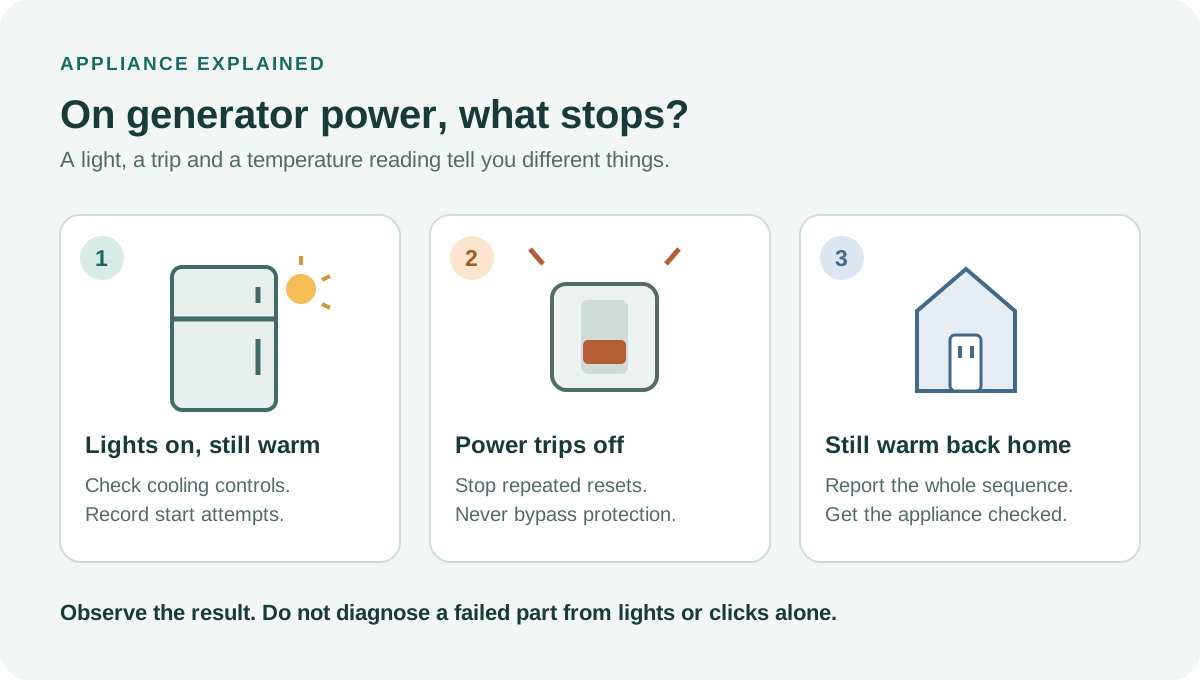
| Lights stay on, but the compartments keep warming | Confirm that cooling is enabled and record whether you hear a brief start attempt or only a fan. |
| The entire refrigerator loses power | Note which breaker or protective device trips and whether other connected equipment loses power too. Do not repeatedly reset it. |
| Cooling works on household power but fails on the generator | Keep the exact appliance, generator and connection details for a compatibility check. |
| Cooling still fails after household power returns | Report the continuing symptoms. Do not assume that more generator capacity will resolve them. |
A bulb and a compressor present different loads. Generator running capacity alone also does not settle whether the connected appliances can start. Check starting requirements as well as running requirements and other loads, using the exact equipment instructions. Do not choose a generator or an adapter from the refrigerator's interior light behavior.
A longer pause did not solve one starting failure
A Frigidaire FPES19BDL1 ran from a wall outlet but would not start its compressor from a generator rated at 1,500 running watts and 2,000 surge watts. The fan ran, and a brief click accompanied the unsuccessful start attempt.
Its owner first allowed a five-minute pause, then tried about twenty minutes without power. Neither restored starting on that setup. Later attempts after a much longer pause did not produce a consistently repeatable result. The owner subsequently reported successful starts using an added start device, then returned the refrigerator to its original starting component.
That last result was not a verified, generally suitable repair. It is not a reason to add a hard-start kit yourself.
The useful distinction is narrower: waiting longer did not reliably solve this particular generator-only failure. Those wattage figures describe the reported setup; they are not a minimum-size recommendation. Follow the restart interval for your appliance, and do not keep repeating failed starts to find a pause that happens to work.
A tripping protective device is a different problem
One Samsung refrigerator connected to a newly purchased generator lost power after roughly ten minutes, prompting repeated breaker resets. At first, its owner suspected the borrowed construction extension cord. Later, the owner reported that a grounding-bypass adapter stopped the problem.
Stopping the trips that way was not a safe repair. The account did not establish whether the refrigerator, cord, generator or their electrical arrangement caused the protection to operate. Removing the ground connection can conceal the symptom while removing protection.
Do not copy that workaround. Stop using a setup that repeatedly trips and have the refrigerator supply arrangement checked by a qualified electrician or appliance technician. Do not remove a grounding pin or bypass a protective device.
Record whether the trip happens immediately, during an attempted start, or after a period of operation. If you already know how the same refrigerator behaves on household power, include that history. Avoid deliberately reproducing a trip to collect more examples.
Check whether cooling was turned off during other work
An Amana residential refrigerator in a motorhome seemed to have stopped cooling after the generator was rebuilt and reinstalled. The air conditioners worked and the refrigerator light came on, so the owner began considering a refrigerator or generator fault.
During the earlier service period, however, the freezer control had been turned off and the refrigerator control left at its lowest setting. After the freezer control was turned back on, the owner reported that the refrigerator worked.
The sequence does not establish a universal control arrangement. On that refrigerator, a setting left off during maintenance was the decisive finding.
Before buying anything, check the labeled cooling controls and any cooling-off mode on your own model. Check both compartment controls if the appliance has them. A working light cannot tell you that a cooling control is enabled. This example concerns a residential refrigerator; it is not a troubleshooting procedure for a propane absorption refrigerator.
If household power returns and cooling still fails
An LG GR-L247NIS was used with a generator during an outage. Its owner heard cycling and initially assumed it was operating, then found thawing and water. Once household power returned, the refrigerator still ran briefly, clicked off and repeated the pattern.
The owner measured a run capacitor below its marked value and replaced it. The same failure continued. No successful repair or final cause was established in that account.
A separate GE refrigerator had a more abrupt history: its owner reported a damaged control board while using an inverter generator. A replacement board worked on household power, but the failure returned when the refrigerator was put back on the generator.
Neither history proves a specific generator defect or a rule about either refrigerator brand. The first contains a failed parts replacement after the outage; the second contains a failure that recurred after a seemingly successful repair and a return to the same supply setup.
Give those different sequences to the repairer as they occurred. If cooling remains absent on household power, arrange appliance service instead of assuming generator sizing is the only issue. If a part has burned or smoked, do not reconnect the appliance to reproduce the failure.
Before buying a UPS, inverter or another generator
Keep the refrigerator model number and the generator's exact identification together. Confirm the required voltage and frequency, the starting and running requirements, and whether the proposed connection method is permitted for that appliance. Advice for another refrigerator is not a compatibility check for yours.
A UPS or a different generator is not an established fix merely because the display stays on. Likewise, a successful start does not establish sustained cooling. Check actual compartment temperatures with an appliance thermometer.
Do not connect a generator to household wiring through a wall outlet. Follow the equipment instructions for an approved connection arrangement; if an extension cord is permitted, it must be suitably rated, intended for outdoor use and have an intact grounding connection.
For a useful service call, write one short sequence: what power source was in use, what stopped, what you changed, and what happened next. Include failed changes as well as apparent successes. “The lights came on” and “the food stayed cold” describe different results.