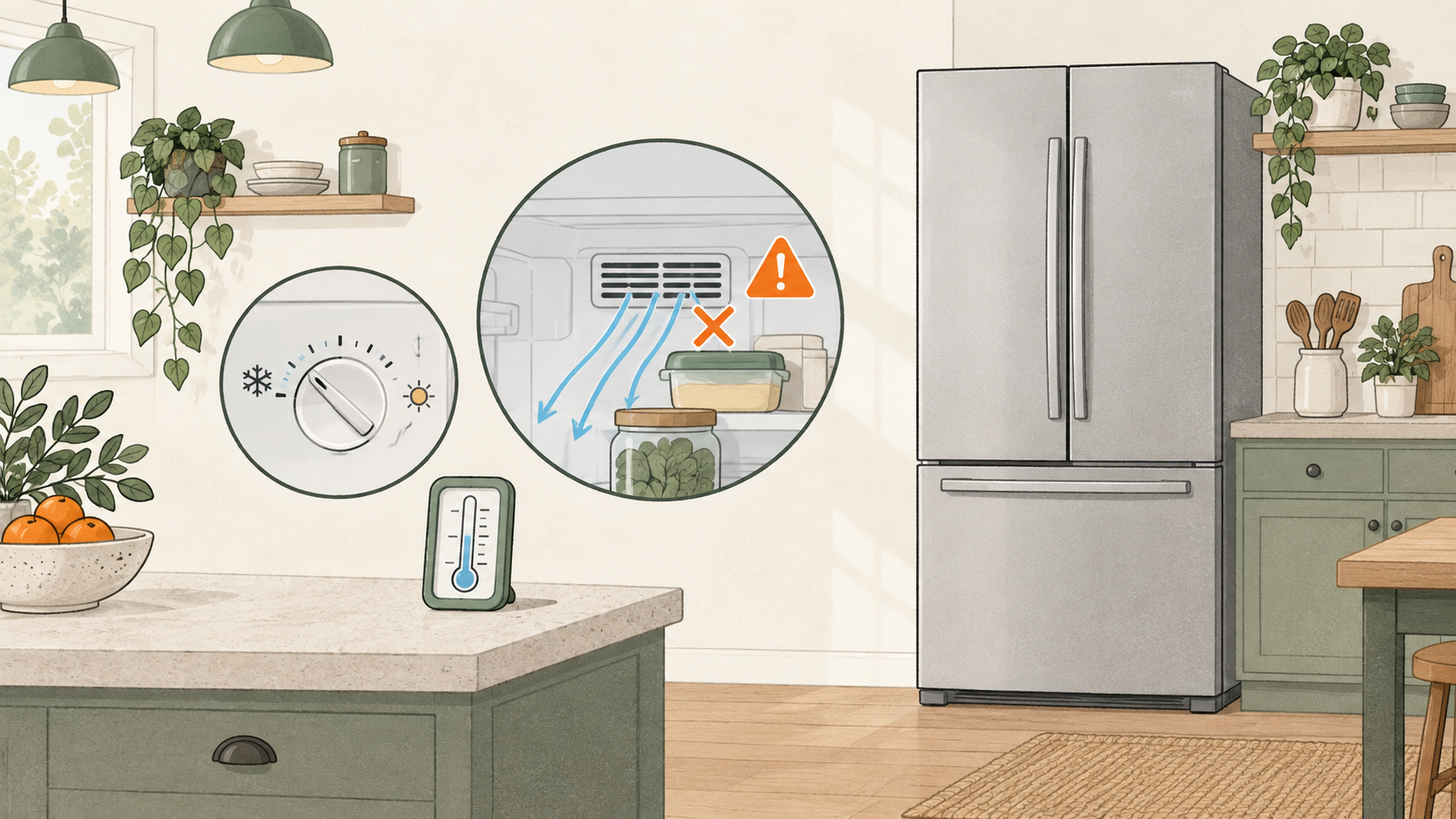
If a refrigerator is warm and clicking, the sound alone does not identify a failed compressor. A single click when cooling starts or stops can be normal. Repetitive clicks can come from an ice maker trying to fill, a control switching an operating part, or a valve changing which compartment it cools. A repeated click followed by no cooling is a different pattern. Start with when the click occurs, where it comes from, whether the refrigerator is actually getting colder and what the display shows.
Do not use “it clicks” as a part diagnosis. Use it as a timing clue.
Step 1: Match the click to an event
Stand beside the refrigerator for one short observation period. Note whether the sound is:
- one click as the compressor starts or stops;
- a rapid, repeating click while the refrigerator is switching between cooling sections;
- a click near the ice-maker or dispenser area;
- a click that repeats while the cabinet stays warm and no cooling sound follows.
The same room can contain several sources. A relay or control can click when it switches a component. A temperature-control or defrost timer can also make a click as it changes state. A refrigerator can therefore click without the click being an alarm.
Now measure the food compartment with an appliance thermometer and write down the time. A setting on the display is not a temperature reading. The temperature trend tells you more than the loudness of the sound.
Step 2: Check the ice-maker branch before blaming cooling
If the click comes from the ice-maker area, ask whether the ice maker has a water supply. On a refrigerator that has an ice maker but is not connected to water, the inlet valve may click or buzz while trying to fill. The safe external check is to turn the ice maker off using the control described in the exact owner’s manual. Do not pull the valve, remove a panel or reach into the mechanism.
If a water line is connected, look only for a visible kink or a shutoff that was closed during a move. The click may still be part of an ice-making cycle, but the warm compartment must be checked separately. A water-line sound does not prove that the sealed cooling system is healthy.
This is the easy branch to miss. The click can be real and unrelated to the temperature problem.
Step 3: Decide whether a repetitive click can be a normal cooling change
Some refrigerators use separate evaporator paths for the fresh-food and freezer compartments. A documented example describes rapid repetitive clicking while a valve regulates cooling from one compartment to the other. In that situation the clicking is a normal operating sound.
That explanation only fits when the refrigerator is otherwise holding temperature and the click follows the operating pattern described for the model. It does not explain a cabinet that stays warm all day. Compare the measured temperatures with the settings, keep the doors closed while the unit runs, and check that visible interior vents are not blocked by food.
A single click at startup is also not a failure verdict. A compressor can click as it starts or stops. If the click is followed by a normal cooling cycle and the temperature falls, record the pattern and continue observing. If it clicks repeatedly but never starts a cooling cycle, stop treating it as a normal sound.
Listen for sequence, then check temperature.
Step 4: Separate a sound clue from a cooling failure
Use the following order before contacting support:
- Confirm the refrigerator is powered and the controls are not in a model-specific cooling-off or demo state.
- Measure the fresh-food and freezer compartments instead of judging by touch.
- Check that doors close evenly, the visible gasket is clean and no package blocks an air vent.
- Record the click’s location, interval and what happens immediately afterward.
Do not repeatedly unplug the refrigerator to make a clicking sound disappear. Do not remove the rear cover, test a live circuit, touch a fan or work on sealed refrigeration tubing. Those steps move beyond an owner check.
If both compartments remain warm, the click repeats without a cooling cycle, the breaker trips, a burning smell appears or the only next step requires opening the cabinet, use the manufacturer’s service path. Give support the model number, measured temperatures, display state, sound timing and what changed after each safe check.
The click patterns in one view
| What you observe | Possible explanation | What it cannot prove | Next step |
|---|---|---|---|
| One click as cooling starts or stops | A relay, control or compressor start/stop event | That the compressor is defective | Check the temperature trend and the model’s normal-sound guidance |
| Rapid repetitive clicks while compartments hold temperature | A valve may be switching cooling between sections on some designs | That every refrigerator with this sound is normal | Compare the pattern with the exact manual; service it if temperatures are rising |
| Click near an ice-maker with no water line connected | The inlet valve may be trying to fill the ice maker | That the cooling system has failed | Turn off the ice maker using the model’s control and observe whether cooling is normal |
| Click after a move with a kinked visible water line | The ice-maker or dispenser branch may be reacting to restricted water | That the line is the cause of warm food | Check the visible line and keep the temperature check separate |
| Repeated click, no cooling cycle and warm compartments | A start or control problem may need service | Which internal part has failed | Stop opening the cabinet and contact manufacturer support |
| Click occurs only during defrost or a control change | A timer or control transition may be audible | That a new fault has been found | Note the timing and compare it with the exact model instructions |
When to stop
Stop immediately if you smell burning, see damaged wiring, find water near an outlet, hear harsh repeated starting attempts, or would need to remove a cover. Keep hands away from fans, relays, capacitors and sealed tubing.
If the refrigerator is not keeping food cold, protect perishable food while you investigate. A normal-sounding click is not a food-safety test. The measured temperature and the model’s safety instructions decide the next step.
FAQ
Is a clicking refrigerator always broken?
No. A single click at compressor start or stop, a control transition or an ice-maker fill attempt can be normal in the documented conditions. The question is whether the refrigerator is maintaining temperature and whether the timing matches the model’s instructions.
Why does my refrigerator click but never start cooling?
Repeated clicks with no cooling cycle are a service clue, not a part name. Check power, settings, measured temperatures and visible door or vent conditions. If the click continues or the cabinet remains warm, contact support instead of opening the rear panel.
Can an ice maker make a clicking sound when the refrigerator is not connected to water?
It can on models that try to fill an ice maker without a connected supply. Turn the ice maker off using the exact model control. Do not assume that this explains a warm refrigerator; check the food temperature separately.
What if the click is normal but the refrigerator is still warm?
Treat the sound and the temperature as two separate clues. Check the setpoint, measured compartment temperatures, door seal and visible vents. A normal sound does not prove that cooling performance is normal.
Should I unplug the refrigerator to stop the clicking?
Do not use repeated power cycling as a diagnosis. If the manual gives a specific owner reset, follow that exact instruction once. A click that returns with warm compartments needs the manufacturer’s support path.