If your dishwasher is not drying, first confirm that the cycle finished, then check the drying option and liquid rinse aid. Wet plastics or water trapped in cup bases need a different response from an entire wet load. Before propping the door open, check your model's drying system: some doors open automatically, while some fans need the door left closed.
Did the dishwasher actually finish?
Check the end-of-cycle indicator in your manual. A stopped machine with dirty dishes, detergent still present or substantial water covering the tub floor may have a washing or drainage problem before drying can begin. Follow the relevant dishwasher not cleaning or dishwasher not draining checks first.
Record any error rather than repeatedly restarting the machine. A cleared display alone does not prove that the next wash and dry cycle completed.
Which items are wet?
Look at the whole load before choosing a fix.
- Mostly plastic containers: plastics often remain wetter than glass and ceramic. Use a compatible drying option and allow time to cool; a few wet plastics alone do not identify a failed heater.
- Puddles in recessed cup bases: angle items as the loading instructions allow so water can run off.
- Water between nested bowls or touching containers: separate them and avoid overcrowding.
- Droplets on the tub walls: judge the dishes as well. Interior moisture alone is not the same symptom as every plate staying wet.
When unloading, start with the bottom rack so water retained above does not spill onto dry items below.
Check the cycle before changing parts
Quick or air-dry programs may leave more moisture than a full program with a heated or extended drying option. Choose an option your machine actually offers, and check that the items tolerate it. An option described for another dishwasher may not exist on yours.
For example, a Whirlpool WDTA50SAKZ3 owner reported wet dishes on Normal with Heat Dry, then no improvement on Heavy with Extended Dry. A rinse-aid refill was the next planned trial; no successful result was reported. That history shows the limit of a cycle comparison: continued wetness calls for another check, not an automatic heater diagnosis.
Use the rinse-aid dispenser, even with combination pods
If your manual calls for liquid rinse aid, fill its reservoir to the marked level and wipe up spills with a damp cloth. Combination detergent does not necessarily replace rinse aid delivered separately during the final rinse. Adjust the dose only as your manual describes.
More is not automatically the answer. A Whirlpool WDF520PADM7 owner added rinse aid, then tried the maximum setting, but still reported wet dishes. The discussion did not establish a successful repair. If filling and a permitted adjustment make no difference, keep that result for service instead of continuing to increase the dose.
Read a Whirlpool-style gauge with the door fully open
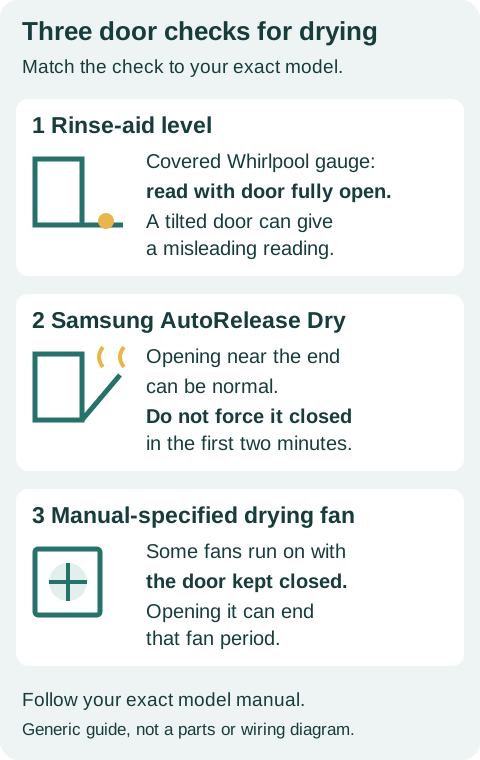
For dispensers covered by Whirlpool's rinse-aid level guidance, the indicator is accurate with the door fully open. A partly raised door can give a misleading reading.
Read it in that position before deciding the reservoir is empty. If you are tracking consumption, compare readings in the same fully open position. The gauge is a level check; it does not by itself prove whether the dispenser released rinse aid correctly.
Samsung AutoRelease: an open door can be normal
On Samsung models with AutoRelease Dry, the door opens near the end of the cycle. Do not force it closed: Samsung says it cannot be closed during the first two minutes after automatic opening and is intended to remain open for drying.
If AutoRelease is disabled, drying can suffer. Check the setting instructions for the exact model:
- DW80R9950: A1 enables AutoRelease; A0 disables it.
- DW80CG5020 / DW80CG5451: J1 enables it; J0 disables it.
These codes are not universal Samsung settings. Use your manual's button sequence. If the feature is enabled but the door does not open, check for an obvious cabinet obstruction without pulling out the dishwasher. Have the installer check clearance and leveling; arrange service if the problem remains.
A drying fan may need the door left closed
Do not apply advice to crack the door open to every drying system. Whirlpool's multi-brand fan guidance describes some fan-assisted models whose fan can continue for up to eight hours, depending on the model and cycle, or until the door is opened.
If your own manual describes that behavior, leave the door closed when you want that designed fan period to finish. Opening it ends the fan operation described in that guidance. This is not an eight-hour rule for all Whirlpool dishwashers, and it does not mean every long-running fan is normal.
For a model whose manual permits manual door opening after completion, follow that instruction instead. Keep clear of escaping hot steam.
Check the incoming hot water
On dishwashers whose installation instructions require a hot-water supply, run the nearby hot tap until the water is hot before starting. If the hot-water supply has failed, resolve that supply problem before judging the drying result. Do not change water-heater settings or dishwasher plumbing based on a generic drying guide.
One Whirlpool WDF520PADM9 owner reported drying trouble after a water-heater failure. Restored hot water and further checks did not resolve it. After an element replacement, the owner reported that drying returned but the Sanitize light still blinked. That is a reported partial improvement, not proof that the whole appliance was working correctly or that another machine needs an element.
When to arrange service
If a completed, suitable cycle with correct loading and rinse aid still leaves the whole load unusually wet, contact service with the model number, cycle, options, error messages and the checks already tried. Mention whether the problem began after installation, a hot-water interruption or a repair.
A KitchenAid KDTE204KPS owner tried heated and extended drying, rinse aid and a power reset without improvement. A service visit led to a suspected control-board problem and an ordered part; a completed repair was not reported. A proposed part remains a proposal until the repair is tested.
Stop using the machine for a burning smell, smoke or leakage. Do not touch an element to test for heat, remove panels, bypass a float or door switch, or perform live electrical tests. Heater, fan, dispenser and control faults need model-specific diagnosis; wet dishes alone cannot distinguish them.