If your microwave is sparking, stop the cooking cycle immediately. Once it is safe and cool, look for metal packaging, unsuitable dishes, food residue or a displaced rack. Leave it off if you find a burned cover, peeling cavity coating, a damaged door or unexplained recurring sparks. Do not keep restarting it to see whether the flashes disappear.
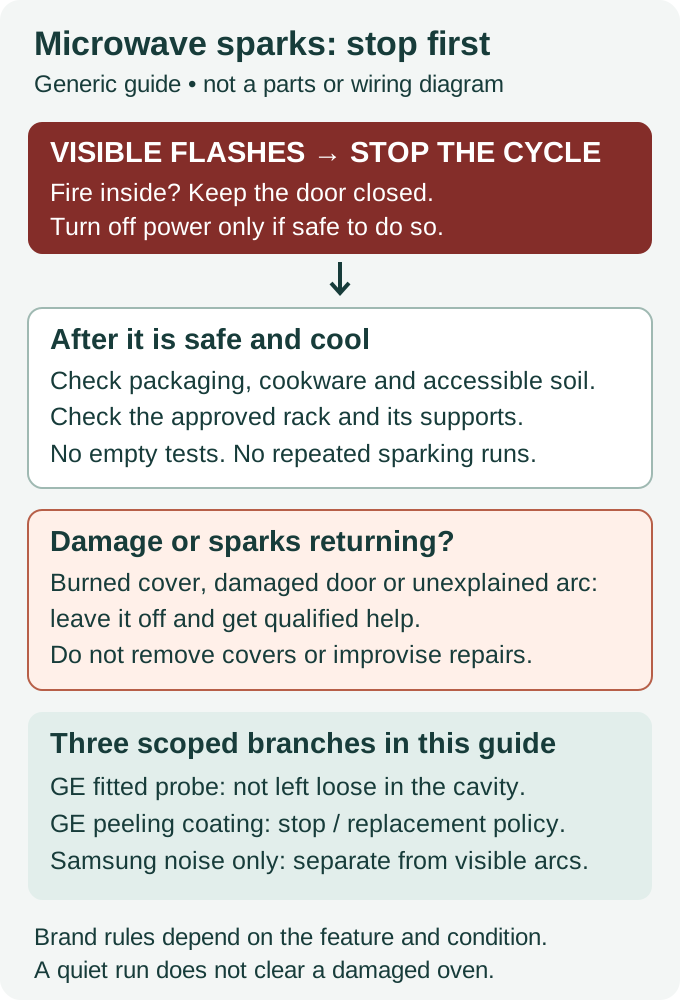
This guide covers visible flashes inside a household microwave, including a microwave-and-oven combination used in microwave mode. The GE, LG and Samsung checks below apply only to the features described.
If there is smoke or fire, keep the door closed
Turn the oven off. If something inside is burning, keep the door closed and disconnect power at the plug or circuit breaker only if you can do so safely. If the fire continues or you cannot safely control the situation, leave and call emergency services.
Do not open the outer cabinet, remove a vent grille to investigate, bypass the door switches or work on the high-voltage components. Unplugging a microwave does not make its internal electrical parts safe to handle. A damaged door, latch or sealing surface also means stop using it and arrange qualified service.
Check the dish and packaging after the oven has cooled
Look for a twist tie, staple, foil liner, utensil or metallic trim on a plate. A dish can look ceramic and still have a metal-containing decoration. Transfer the food to a known microwave-safe container and keep the suspect item out.
Do not turn this into a series of trial runs with different dishes. One owner saw arcing with a ceramic bowl, then again after switching to plastic. After cleaning, the owner still sought advice; the later reported resolution involved a replacement waveguide cover. That is an individual outcome, not a reason to order a cover for every sparking microwave.
A normal cycle afterward is only reasonable when an obvious removable cause has been corrected, the cavity and door are undamaged, and the model's instructions permit continued use. Stop at once if sparking returns. Never test an empty oven.
Sparks coming from the food need a different response
Some vegetables can arc even with no metal utensil present. Maytag identifies high-mineral vegetables as one example. If the flashes were in or on the food, stop the cycle and finish cooking it by another method.
Do not assume every flash near a vegetable is harmless food arcing. A scorched wall, damaged cover or repeated flash from a fixed point needs the appliance checks below. Do not deliberately recreate the sparks to locate them.
A supplied metal rack still has placement rules
Use only the rack supplied or approved for the exact model, in a cooking mode that allows it. An oven-safe baking tray is not automatically suitable for microwave mode. Follow the manual's instructions for the rack, its supports and any crisping pan.
On LG microwaves equipped with the metal rack described in LG's sparking guide, all four plastic support brackets must be intact and the rack must sit correctly on them. A broken support needs service. Do not bend the rack or improvise a spacer to keep metal away from the wall.
Clean accessible residue, without scraping the coating
With the controls off and the oven cool, follow its cleaning instructions. Mild soap and a soft damp cloth are appropriate for many models; rinse away residue and dry the accessible surfaces. Check the ceiling as well as the walls, turntable area, rack supports and the area where the door meets the frame.
Maytag warns against abrasive cleaners and steel-wool pads on the cavity. Do not scrub a burn mark until the coating comes away. A steam-cleaning routine for an otherwise working microwave is not a reason to run an oven that is currently arcing.
In a discussion about a Bosch combination microwave, one owner said cleaning only the wheels had not helped, while cleaning the cavity sides later stopped the sparking. Others in that discussion still had recurring trouble. Residue can be relevant without being the explanation for every similar-looking mark.
A scorched waveguide cover is a stop point
The waveguide cover shields the opening through which microwave energy enters the cooking cavity. Its material, shape and location vary. If it is burned, cracked, holed or missing, leave the appliance off and ask the manufacturer or a qualified technician about the correct part and any damage behind it.
Do not remove the cover for a test, substitute tape or plastic, or assume a cut-to-size sheet is approved for your appliance. A cover is not a shield that makes internal electrical repair safe. Sparks can have more than one cause, so a new cover alone does not prove the microwave is sound.
GE models with a cooking probe: do not leave it loose inside
Some GE microwaves have a manufacturer-provided cooking probe. GE says leaving that probe in the cavity without inserting it into the food can cause arcing.
If your model has this feature, remove the probe when it is not being used, following the manual. When using it, follow the model's insertion and connection instructions. This exception is for the specified appliance probe; it is not permission to put an ordinary metal meat thermometer in a microwave.
If the probe or its connection appears damaged after arcing, stop and have it assessed before using the feature again.
GE cavity paint: distinguish a small chip from active peeling
GE's cavity-repair guidance distinguishes minor chips, which it says do not affect performance, from coating that is actively flaking or peeling. For active peeling anywhere inside a GE microwave, including beneath the turntable, GE advises discontinuing use and replacing the oven. Its dedicated cavity guidance also recommends replacement for a hole in the cavity.
GE does not offer an approved interior repair method for these chips, burns or scratches, or an interior touch-up paint for microwaves and Advantium ovens. Do not treat a bottle labeled “microwave paint” as GE approval.
A small chip does not explain away actual sparking. If the oven is arcing, leave it off while the cause is assessed. For another brand, get that manufacturer's disposition for the exact cavity damage; do not apply GE's replacement policy to every microwave.
Only a popping sound, with no flashes or damage?
A popping sound alone is not proof of electrical arcing. Samsung says foods with substantial fat or water can make popping sounds as they heat. This noise-only branch does not apply if you saw flashes, smell burning or find damage.
For an otherwise undamaged Samsung microwave with unexplained popping, Samsung recommends cleaning the interior and then checking with water in a microwave-safe container. Follow your model's water-check instructions; do not invent a long heating time or boil the water. If popping persists during that check, request service. Stop immediately for any flash or burning smell.
Do not use this check to clear a microwave with a burned cover or peeling coating for further use.
Sparks that return need a service history, not another reset
Leave the microwave off if sparks recur after the obvious external cause has been removed, or if they appeared behind a grille rather than in the food cavity.
A Panasonic NN-SD277BR owner initially ran the vent fan after an episode associated with steam from the stove. The apparent recovery lasted about three weeks before sparking and smoke returned. The owner then cleaned an accessible interior cover and discussed replacement parts, but the posted exchange did not confirm a repair.
In another report, a ZLINE MWO-24-SS had a melted support near the rotating plate. A temporary adjustment did not provide a lasting solution; the manufacturer later offered a replacement turntable. The visible exchange did not establish a completed, durable repair. Neither story identifies the failed part in someone else's microwave.
When arranging service, give the model number, the location of the flash you already observed, the food and container involved, the selected mode and any visible damage. Mention previous cleaning or part replacement and whether the problem returned. Do not run the oven again to obtain a video.
If your appliance has no sparks and the actual symptom is different, see microwave not heating, heating that stops after a few minutes or a turntable that does not rotate.