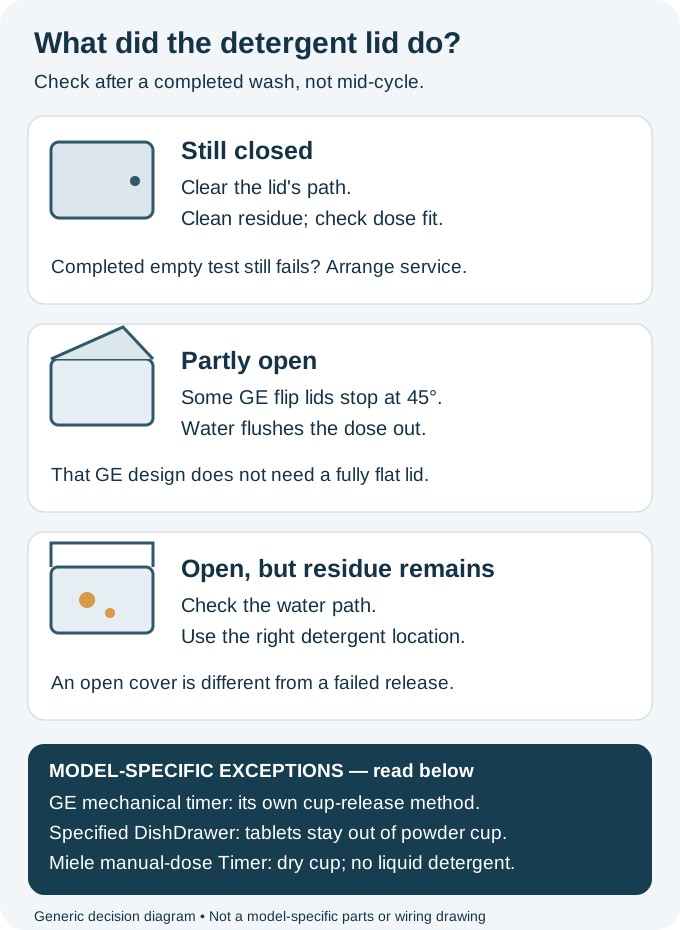
If your dishwasher's soap dispenser stays closed after a completed wash, first clear anything blocking the lid and gently clean detergent buildup from its latch. Do not pry it open or replace the dispenser just because a pod remains inside. A partly open lid can be normal on some GE designs; an open lid with detergent left behind calls for a water-path check.
Was it a completed wash?
A closed cup during an interrupted program does not establish a failed release. Check whether the dishwasher actually finished a wash rather than a rinse-only program. If it stopped with an error, resolve that interruption first. On Samsung machines, an error can prevent detergent dispensing; the empty-cycle check below is useful only if that cycle completes.
If standing water is the main symptom, start with dishwasher not draining. Repeating a wash will not answer the dispenser question while the machine is unable to finish it.
Give the lid room to move
With the machine stopped and the door open, check the space immediately in front of the dispenser. A pan handle, tall plate or utensil can obstruct the cover even when the main dishwasher door closes normally. Move the item, then check the lid's path with the racks pushed into their operating positions.
LG's guidance adds a rack-specific check: on models with an adjustable upper rack, a low rack position can interfere with the dispenser. Raise it using the model's rack instructions if that is the obstruction. Also keep large pans from shielding the cup from wash water. Clearance for the lid and clearance for water are separate checks.
Clean the latch, then check the detergent fit
Wipe accessible residue from the cup edge and latch with a warm, damp soft cloth. Remove softened buildup gently; do not force a jammed cover. Once clean, check whether the normal release button opens it and whether the lid latches without pressure from the detergent.
Keep the cup dry before loading fresh detergent. A damp or caked dose can stick, and a tablet wedged against the cover can physically hold it shut. Keep gel within the dispenser's marked fill limit. These checks are more useful than repeatedly adding extra detergent to a cup that has not emptied.
A partly open GE lid may be working normally
Some GE flip-open detergent lids stop against the upper rack at about a 45-degree angle. That position alone does not mean the release failed: water from the lower spray arm is intended to wash detergent from the cup.
Look at what remained after the completed cycle. If the lid released but the dose stayed behind, check loading around the cup and the water path. Do not bend the hinge to make it lie flat. This explanation applies to the GE flip-lid design described here, not every sliding or rotating dispenser.
Use Samsung's empty-cycle check to separate two problems
After cleaning and clearing the dispenser, Samsung recommends running a cycle with no dishes and no detergent, with the dispenser closed.
- The cycle finishes and the lid opens: review how the load was blocking the lid or spray path.
- The cycle finishes but the lid stays closed: request service.
- The cycle does not finish: address the error or interrupted cycle before judging the dispenser.
An open lid with detergent residue is a different observation from a lid that never released. If the cup opens but the dishes stay dirty, see dishwasher not cleaning dishes.
GE with a mechanical timer knob: release the cup correctly
For GE dishwashers with the mechanical timer control covered by its instructions, start at OFF and rotate the timer one complete revolution clockwise. The detergent cup should open. With the dial at OFF, the cup can also be opened by turning its handle counterclockwise.
Do not force the cup, and do not apply this method to an electronic-control dishwasher. It is a way to release the cup on that control design, not proof that an automatic release fault has been repaired. If the cup still fails to open during a wash, arrange service.
DishDrawer: the powder cup is not the tablet holder
The Fisher & Paykel US/Canada guide for DD24DTX6I1, DD24DTX6HI1, DD24STX6I1, DD24STX6HI1, DD24DTX6PX1 and DD24STX6PX1 specifies a dry dispenser for powdered detergent. It says not to put tablets or pouches in that dispenser.
For those models, a tablet or pouch belongs in the cutlery basket or its tablet tray, clear of dishes and cutlery, or between the racking at the side shown in the manual. Do not put it on the drawer base, where it can obstruct the spray arm.
If you have been putting a pouch in the powder cup, correct its placement before deciding the cup is defective. Use the instructions for your exact DishDrawer; this placement rule is not permission to throw a pod onto the floor of any dishwasher.
Miele Timer: check what happened before the delayed start
For manual detergent dispensing on the Miele HG07-W covered by US manual M.-Nr. 12 783 760, the Timer instructions require a dry detergent compartment. Moisture can make detergent clump before the delayed program starts and leave it incompletely rinsed out.
Dry the compartment first and add detergent just before activating Timer. Do not use liquid detergent with this Timer setup: it can leak out. This branch concerns manual dispensing, not an AutoDos cartridge.
If the problem appears after a delay but not with an immediate start, note that difference when checking the cup. It is useful context, not a diagnosis of a broken latch.
Do not bypass a conventional main-wash cup
On the conventional dispenser described by Whirlpool, pods belong in the main-wash compartment with its lid closed. Leaving the lid open or putting the dose in the tub changes when the detergent is available. Follow the machine's detergent instructions rather than using an early release as a permanent workaround.
The DishDrawer placement above is a specific exception. It does not contradict a conventional machine's requirement to hold detergent in a closed cup.
When the lid still will not release
A broken cover, damaged latch or failure after the manufacturer's completed empty test needs service. Being able to open the cup by pressing its button only confirms that it can move manually; it does not identify whether its automatic release or control is working.
In one KitchenAid KDTE304GPS owner report, multiple empty cycles still left the lid closed; the owner later reported that a warranty technician replaced the control board and restored operation. That is one machine's repair history, not a reason to order a board for yours. An unsuccessful empty test narrows the next step to service, not a particular part.
Give the technician the model number, whether the program finished, the lid's final position, the detergent type and the result of any empty test already completed. Keep those observations separate from guesses about the spring or control board. Leave door-panel removal, wiring checks and powered tests to the technician.
Official references
- KitchenAid: dispenser not opening
- GE: detergent cup did not open and mechanical timer cup release
- LG: dispenser does not open completely
- Samsung: detergent does not dispense
- Whirlpool: detergent door will not open
- Fisher & Paykel: specified DD24X6 DishDrawer guide, pages 18–19
- Miele: HG07-W US guide, Timer instructions on page 60