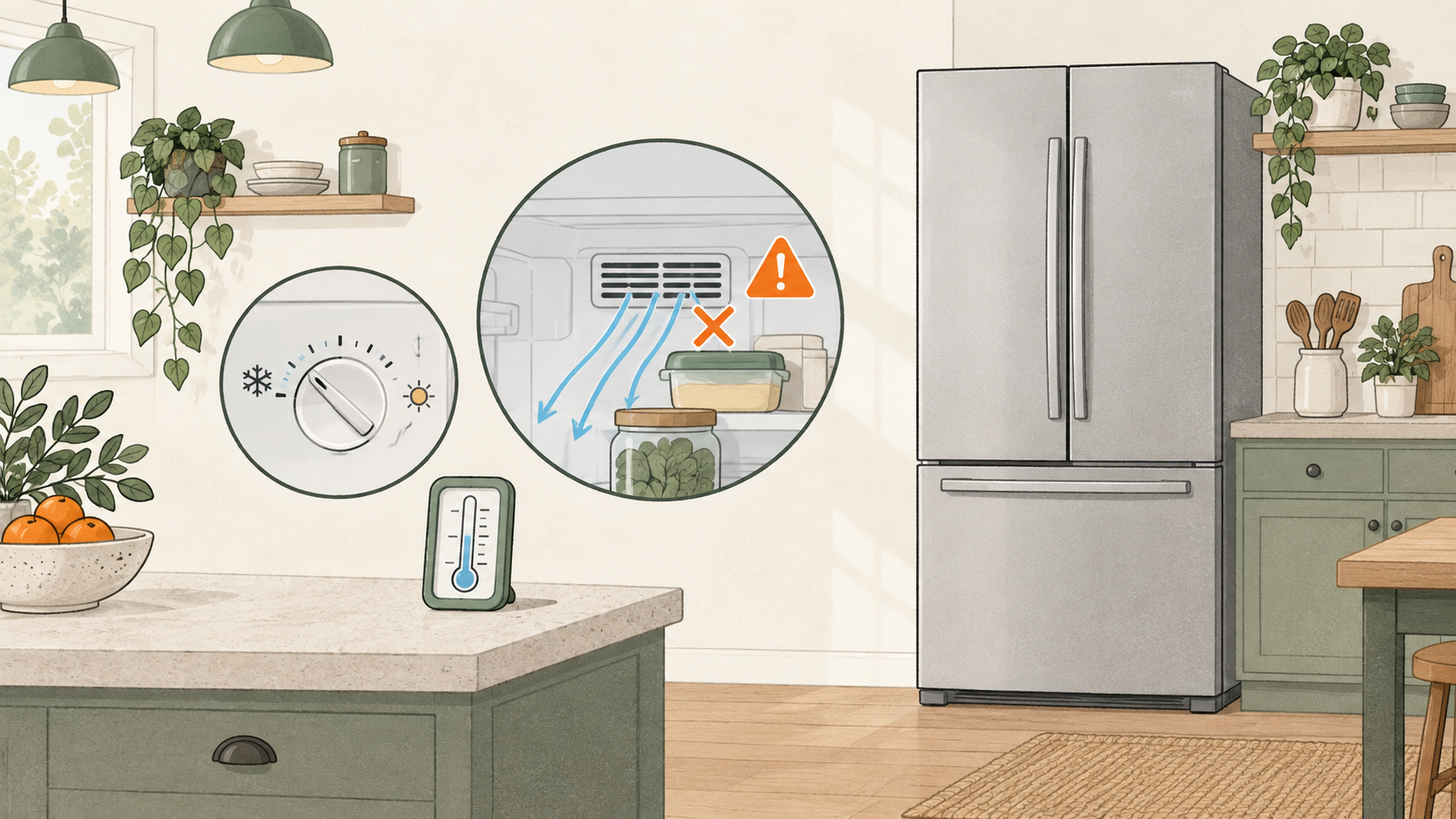
If a refrigerator is still warm after coil cleaning, do not assume the cleaning caused the problem—or that doing it again will solve it. First confirm that power is back, any grille removed for the job is secure, and no visible power cord is pinched after the refrigerator was moved. Then measure the refrigerator and freezer temperatures. If the next step would require opening a service panel, stop there.
First check: were those coils meant to be cleaned?
Coil location and owner-cleaning instructions vary by model. Some refrigerators have condenser coils in a place an owner cannot safely reach; some models do not require routine coil cleaning, and some direct the owner to use a technician. A “not cooling” symptom alone is not a reason to remove a cover or reach behind one.
Most GE refrigerators made since 2001 use a NeverClean condenser, with compact models and smaller-capacity top-freezer models as exceptions. This is specific to that product family, not a rule for every refrigerator. Look up the instructions for your exact model before planning another cleaning.
If the manual does not identify the coils as an owner-maintenance task, do not try a different brush, tool, or access route. Leave the panel closed and move to the outside checks below.
Check what changed during the cleaning
Cleaning may mean the appliance was unplugged, a grille was removed, or the cabinet was pulled away from the wall. Check only what you can see without reaching behind a panel:
- Is the refrigerator plugged back into its normal outlet, and is the display or interior light on?
- If a grille was removed, is it back in place and seated as the model instructions show?
- If the refrigerator was moved, is the visible power cord free of pinching?
- Is the refrigerator back within the clearance required by its manual?
Do not pull the refrigerator out while it is powered just to inspect the rear. If you cannot safely see the cord or line, leave it alone and ask for help. A grille left off, a pinched cord, or a change in clearance is worth checking; none of those observations proves what has failed inside.
Measure both compartments before deciding it is still getting worse
Use an appliance thermometer rather than the display setting or a quick feel of the air. Record the refrigerator and freezer readings and the time. A warm refrigerator with a cold freezer is a different pattern from both compartments warming together; neither pattern identifies a part by itself.
If perishable food is above 40°F (4°C), protect it while you investigate. Do not wait for a diagnosis before moving food that cannot stay safely cold. The broader refrigerator temperature and food-safety checks explain what to do with the reading.
Do not treat a recovery period stated for a newly installed refrigerator as a coil-cleaning timer. Use the recovery instructions in your model’s manual, keep the doors closed as much as practical, and compare actual readings over time rather than repeatedly changing settings.
A short recovery and a lasting recovery are not the same thing
“I cleaned the coils” is only the start of the story. Cooling can improve briefly, fail to change, or return unevenly between the two compartments.
An older Hotpoint top-freezer, model HTS22GBPARWW, cooled normally for about a week after its coils and fan were cleaned and the freezer was defrosted. Then a louder thrumming and rattling sound returned; the refrigerator compartment was about 50°F, and frost was building again in the freezer. Even after the defrost thermostat, temperature sensor, and defrost heater were replaced, the coils kept icing. A brief recovery was not a confirmed fix.
An Amana bottom-freezer, model ABB1924brw, showed a different split: the refrigerator area reached about 50°F, no cold air came through its upper vent, and the freezer kept running. Cleaning the coils and leaving it unplugged for several minutes did not restore cooling. Airflow returned after a longer defrost, while the freezer was at −8°F; the cooling problem was eventually resolved after a control-board replacement. That outcome does not make defrosting or part replacement a safe next step for another model.
On a Whirlpool Gold side-by-side, model ED25LFXGN00 (made in July 1999), the readings swung after the coils were cleaned: after four hours, the freezer was at −15°F and the refrigerator at 28°F. By the next day, the refrigerator was back to 45°F while the freezer was below zero. A colder reading after cleaning did not establish a lasting recovery or identify a cause.
An Amana bottom-freezer, model ABL2522FES, followed a less dramatic but equally important path: cleaning the coils did not help, replacing its control board did not solve the cooling problem, and the condenser fan still seemed to run. A cleaned coil and a running fan still do not identify the cause.
If your refrigerator improves and then warms again, record both temperatures and when the change happened. If the pattern includes returning frost, unusual noise, or no improvement after the permitted outside checks, stop repeating the cleaning and move to model-specific support. The sequence narrows what to report; it does not name a part.
What the post-cleaning clues can tell you
| What you notice | What it may indicate | What it cannot prove | Next step |
|---|---|---|---|
| The manual says the condenser is sealed, never-clean, or technician-only | Coil cleaning may not be an owner task for this model | That the coils caused the cooling problem | Stop cleaning and use the exact-model support path |
| The display is dark after cleaning | Power may not have been restored or the outlet may need checking | That an internal cooling part has failed | Check only the normal plug, breaker and controls you can safely access |
| The grille is still off, or the cabinet is not back in its required position | The cleaning job may not be fully put back as directed | That reinstalling a grille will restore cooling | Follow the exact manual; do not reach behind the cabinet while powered |
| Temperatures improve, then warmth and frost return | The symptom may be recurring rather than a one-time effect of cleaning | Which internal part is responsible | Stop at external observations and arrange service |
| Both compartments remain warm and readings do not improve | The problem goes beyond a simple cleaning check | A specific failed component | Protect food and contact support |
When to stop and get service
Stop owner checks if you see a damaged power cord, or if the next step would mean removing an internal cover or reaching near wiring, a fan, or refrigerant tubing. Do not open an internal panel to inspect or clear frost; use only the defrost procedure in the exact model’s manual, or contact service.
When you contact support, have the model number, both temperature readings, when the cleaning happened, whether the refrigerator was unplugged or moved, and whether frost or noise returned. That gives the technician a useful timeline without guessing at a part.
FAQ
How long should a refrigerator take to cool after cleaning its coils?
Do not borrow a new-installation recovery period and treat it as a universal rule for coil cleaning. Follow the exact model manual and compare measured temperatures over time.
Could cleaning the coils make the refrigerator stop cooling?
The timing alone cannot show that cleaning caused the problem. Check whether power was restored, whether a removed grille was reinstalled, and whether the cabinet was moved or a visible cord was pinched. If the temperature remains high, continue with the model’s official guidance or contact service.
Should I clean the coils again if the refrigerator is still warm?
Only if the manual says the coils are owner-accessible and need cleaning. Some refrigerators do not require owner coil cleaning; some require service. Check your model first.
What if it cooled for a while, then frost and warmth came back?
Treat the return of frost, warmth, or unusual noise as a recurring symptom, not proof that another cleaning will fix it. Avoid opening panels or replacing parts; give support the temperature readings and timeline.
Can I use a hair dryer to melt the frost?
Do not use improvised heat or sharp tools on the refrigerator’s internal parts. Follow only the defrost or cleaning procedure documented for your exact model; if it requires removing an internal panel, contact service.
The useful question is not simply “Did I clean the coils?” It is “Does my model allow that cleaning, was everything put back safely, and did the measured temperature improve and stay improved?” If frost or warmth returns, stop treating dust as the whole explanation.