If your washing machine is not filling with water, check that the cycle has actually started, the lid or door is closed, and the required water supply is on. Then inspect the visible inlet hoses and the model's inlet screens. If the display shows a fill error and the controls seem frozen, check the code-specific waiting period before unplugging it again.
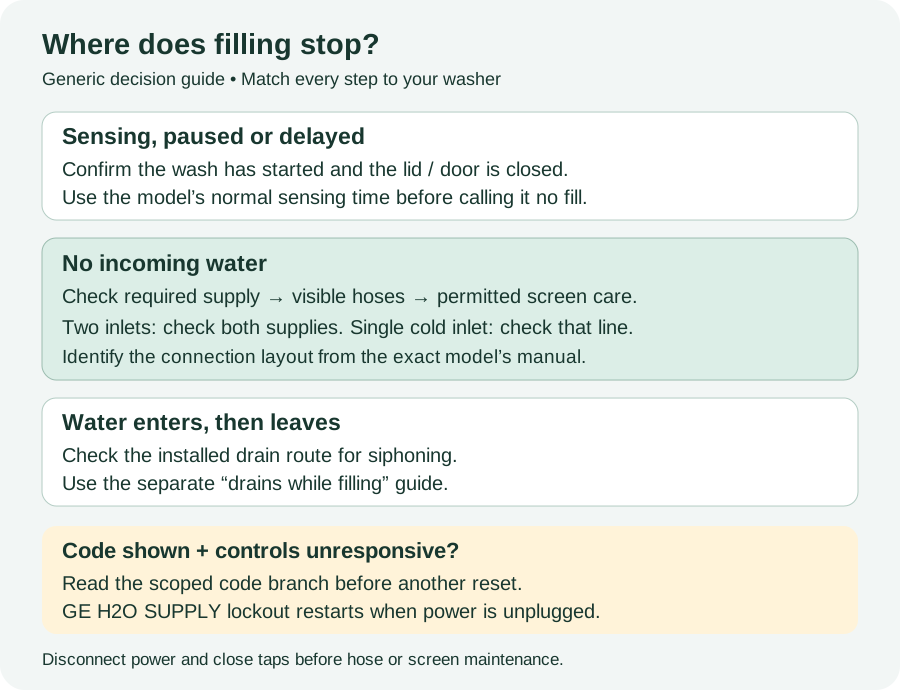
These checks cover household washers. Match the control type and water connections before using a brand-specific step. Stop for a leak, burning smell or damaged electrical connection; do not reach for a plug from a wet floor.
Is the washer sensing, paused or genuinely unable to fill?
A high-efficiency washer does not need to cover the whole load with visible water. A low water line alone is not a fault. Confirm that a wash program is selected, Delay Start is off and the door or lid has closed normally.
On Samsung washers equipped with Weight Sensing, the initial sensing stage can take 2–5 minutes, and an initial drain can be normal. Give that stage time to finish. Water never arriving, a recurring fill code or a cycle that cannot advance needs further checks. Do not force a lock or pour water into the tub to bypass the problem.
A two-inlet washer can need both taps, even on Cold
For the Whirlpool and Samsung two-inlet designs covered by their fill guidance, both the hot and cold connections must have working supplies. Choosing Cold does not establish that an unavailable hot supply is harmless.
If the trouble started after plumbing work, check that both household valves were reopened and the hoses are connected to the matching inlets. Do not force a seized tap. A problem with one temperature setting is useful information for service, but it does not identify a failed valve by itself.
The single-cold-inlet exception
Some Whirlpool compact front-load washers use only one cold-water inlet hose. On that design, check the cold tap and the one hose for a restriction; there is no second hot-water connection to open.
Use the connection diagram for your exact model to identify this arrangement. Do not add a hot connection or borrow the two-inlet checklist simply because another Whirlpool washer has two hoses. A kink in the only inlet hose can stop all incoming water.
Check the external water path before opening anything
Look for a hose crushed behind the cabinet or sharply bent at a connection. Avoid pulling a heavy or stacked appliance across its hoses to inspect it. If other fixtures also have weak flow, the household supply needs attention.
An anti-flood hose or device can also restrict the incoming flow. Whirlpool and Samsung flag this in their fill troubleshooting. Check compatibility with the washer's installation instructions; do not defeat a home's leak-protection system or assume every hose sold as suitable will work with every washer.
Clean the inlet screens only as your model permits
The inlet screens are at the water-supply connections, not the drain-pump filter. Unplug the washer and close its water taps before disconnecting a hose. Have a container ready for retained water, and follow the manual for safe access and reconnection.
Screen removal is not a universal step. Whirlpool's fill-hose instructions say to clean its inlet screens gently in place, without removing or disturbing them. LG's slow-fill guidance describes removing its inlet filters, cleaning them and putting them back. Match that procedure to your washer; do not pull out a screen because a different brand's guide does.
If a screen is damaged, stuck or inaccessible, stop for model-specific help. Reconnect as instructed and check for leaks when restoring the supply. A clean screen rules out visible debris there; it does not prove the whole fill system is working.
GE Fill flashing or H2O SUPPLY: let the lockout finish
On GE top-load models from 2015 onward covered by this guidance, a flashing Fill light or scrolling H2O SUPPLY starts a 3- or 4-minute lockout, depending on the model. The controls will not respond during it.
If there is no leak or other hazard, allow that interval to finish, then choose the settings and press Start. Unplugging the washer starts the lockout period again. Repeated unplugging can therefore keep returning you to the same wait. If filling still fails after the supply checks, arrange service.
This timing does not apply to every GE washer or every frozen control panel.
Older GE mechanical dial: agitates without filling
For a GE top loader with a mechanical dial control that agitates but does not fill, the specified owner check is to select Spin, close the lid and let it spin for at least 2 minutes. Then restart the wash and see whether it fills. If it still will not fill, stop for service.
Use this only for that control type and symptom. The brief basket movements used by a newer washer to sense a load are not the same observation, and this is not a universal two-minute reset.
Whirlpool F8 E1 with a running pump
On the covered Whirlpool front loaders, F8 E1/Lo FL concerns incoming water even though the washer may respond by draining and temporarily ignoring the controls. It is easy to mistake that behavior for a new drain failure.
The Whirlpool code guide's F8 E1 section explains the waiting routine. Photograph the exact code and follow that branch; do not substitute the F9 E1 long-drain procedure.
Water enters but disappears?
That is a different starting point from no incoming water. Check the installed drain route against the exact model's instructions, using the washer drains while filling guide. Do not lower the hose or seal it into the standpipe as an experiment.
If water is instead trapped in the tub, use the washer not draining guide. Neither situation is resolved by repeatedly cleaning an already clear inlet screen.
Still not filling after cleaning the screens?
Once the external supply, hoses and permitted screen maintenance are complete, a recurring failure needs diagnosis. A hum is not proof that water is passing through the inlet valve. The valve, water-level sensing and controls are among the systems a technician may need to distinguish; do not choose a replacement part from the sound alone.
One owner of an older Whirlpool Duet reported clean hoses and screens, a temporary recovery after unplugging, and then the same F8 E1 again. The owner later reported that replacing the inlet valve resolved it. That individual history shows why one successful restart did not establish a lasting fix; it does not show that your washer needs the same part.
For the service request, describe what changed after cleaning, whether any water actually entered, the selected cycle and temperature, and the exact code. Include the model number. Leave cabinet removal, live electrical measurements and internal valve or sensor work to service.