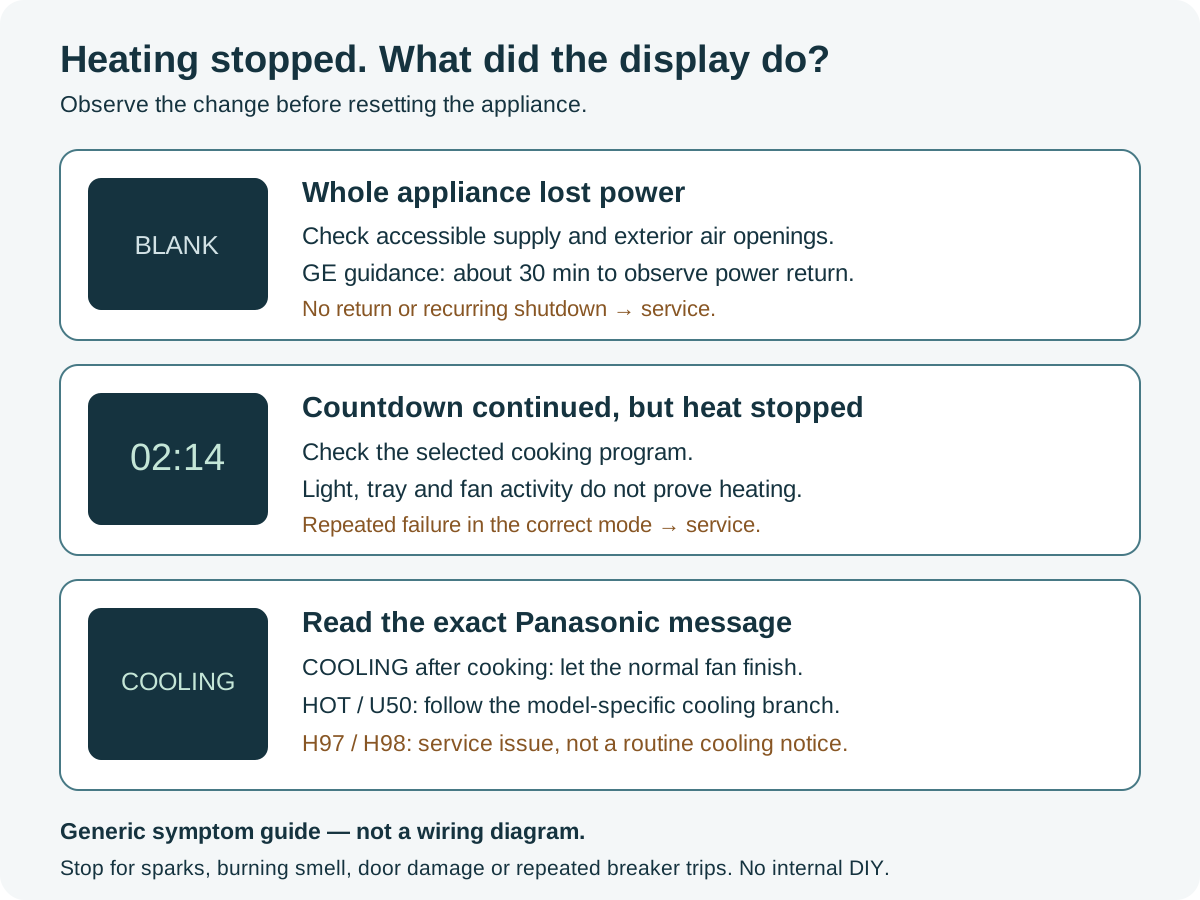
If your microwave heats at first, then stops after a few minutes, check whether the whole appliance went dark, the countdown kept running, or a cooling message appeared. Blocked ventilation can cause a thermal shutdown, but a return to normal after waiting does not identify the failed part. Note the display before resetting anything.
Stop using it if there is a burning smell, sparking, door damage or repeated breaker tripping. Internal microwave components can remain dangerous after unplugging; leave cabinet removal, electrical tests and repairs to a qualified technician.
First, separate an interruption from the end of cooking
A fan running after the timer reaches zero is different from food going cold halfway through a programmed cycle. Record whether the display went blank, returned to the clock, or continued counting down.
If the microwave never heated during that cycle, start with the mode and no-heat checks. That guide covers kitchen timers, Demo mode and low-power settings. Here, the important change is that heating began and then stopped.
The display went blank during cooking
Check the household breaker and, only if the outlet is readily accessible, whether a small lamp works there. Do not pull a built-in or over-the-range unit out to reach a plug. A powered outlet separates a possible appliance problem from a simple loss of supply; it does not prove the supply stays correct under load.
For a GE microwave that loses all power during a cooking cycle, the relevant power-loss guidance allows approximately 30 minutes to see whether power returns after overheating. Keep exterior air openings clear. If power does not return, arrange service.
That is a GE troubleshooting observation, not a universal reset time and not permission to keep cooking in short bursts between shutdowns. A recurring blackout needs investigation even if the clock comes back each time.
Check the air path you can see
On a countertop microwave, look for objects covering intake or exhaust openings and confirm the surrounding clearance against its installation instructions. The factory legs must be in place where the design requires them for airflow. Whirlpool specifically includes the legs in its countertop shutoff checks. Do not remove them to squeeze the appliance under a cabinet, and do not improvise a raised stand as a repair.
For an over-the-range unit, use the manual's filter and ventilation-maintenance instructions. A filter that looks clean is not proof that the entire air path is clear. Do not run the microwave without its required filters or open the cabinet to inspect a fan.
An audible fan is also an incomplete clue. Some designs have a cooling fan separate from the hood vent fan; others use a vent system for cooling too. On applicable GE over-the-range models, heat from the cooktop can start the automatic hood fan and prevent you from switching it off until it cools. Hearing that fan does not confirm that every internal cooling path is working.
Panasonic: read the actual message
These branches apply only to Panasonic models whose instructions use the listed messages. Other brands may assign different meanings to similar codes.
COOLING after cooking has finished
COOLING indicates normal cooling of electronic components. It clears when the fan stops. For ordinary post-cooking fan operation, leave the appliance plugged in until the cooling fan finishes, as Panasonic recommends.
This does not explain away a separate mid-cycle failure. If cooking stopped unexpectedly before the set time, retain that detail even when a cooling fan also runs. The advice to let normal cooling finish does not override a fault that requires stopping use.
HOT, HOT INSIDE WAIT or U50
HOT / HOT INSIDE WAIT can mean the cavity is still too hot from previous use for an automatic program. Let it cool rather than repeatedly trying that program.
U50 needs the operating mode as well as the code: on applicable combination models it can indicate an overheated cavity, or a room temperature above the selected fermentation temperature. Let the oven cool and follow the model's instructions; resume only after the message clears. Do not apply the fermentation explanation to a microwave without that feature.
H97 or H98
H97 and H98 are service issues in Panasonic's no-heating guidance. Contact an authorized service center. Treating either as a routine cooling notice, or repeatedly resetting it because one later attempt heats, can leave the original problem unresolved.
The countdown continues, but heating does not
Check the selected program before assuming a fault. Defrost, lower-power cooking and Keep Warm can behave differently from a continuous high-power cook; the main no-heat guide explains these setting checks.
A repeated loss of heat during a correctly selected cooking cycle needs service even if the light, tray or fan continues. Do not press on the door, alter a latch or hold the door in a special position to make it heat. If normal door movement changes the symptom, report that observation and stop using the appliance.
Why a reset that works once is not a diagnosis
Different owner histories show how misleading a brief recovery can be. In one three-year-old GE over-the-range case, unplugging restored only the first cycle; a later filter experiment improved restarting. That supports checking approved exterior maintenance, not assuming every intermittent failure has the same cause or copying filter-free operation.
A built-in microwave that went completely dark did not respond to an initial breaker reset. It later recovered after unplugging, waiting, cleaning around the installation and another supply check. Because several things changed, the recovery could not isolate what fixed it.
A GE JVM1752SP1SS had a different pattern: resetting power produced a long blank display followed by garbled characters. The owner reported improvement after a control-board replacement and contact cleaning. By contrast, a Samsung ME21F707MJT still failed intermittently after a breaker reset and a board reconnection; a later successful run did not establish a repair. These are individual histories, not instructions to open your microwave or order either part.
Give service the sequence, not just “it stopped”
Describe the first successful heating period, what happened next, and whether the display lost power or kept counting. Include the exact code and model, the program selected, whether the cooktop below was in use, and how long any spontaneous recovery took. Mention resets or previous repairs and whether their benefit lasted.
You do not need to provoke another shutdown to collect this information. A photo of the message and notes from the last failure are more useful than repeated restart attempts.