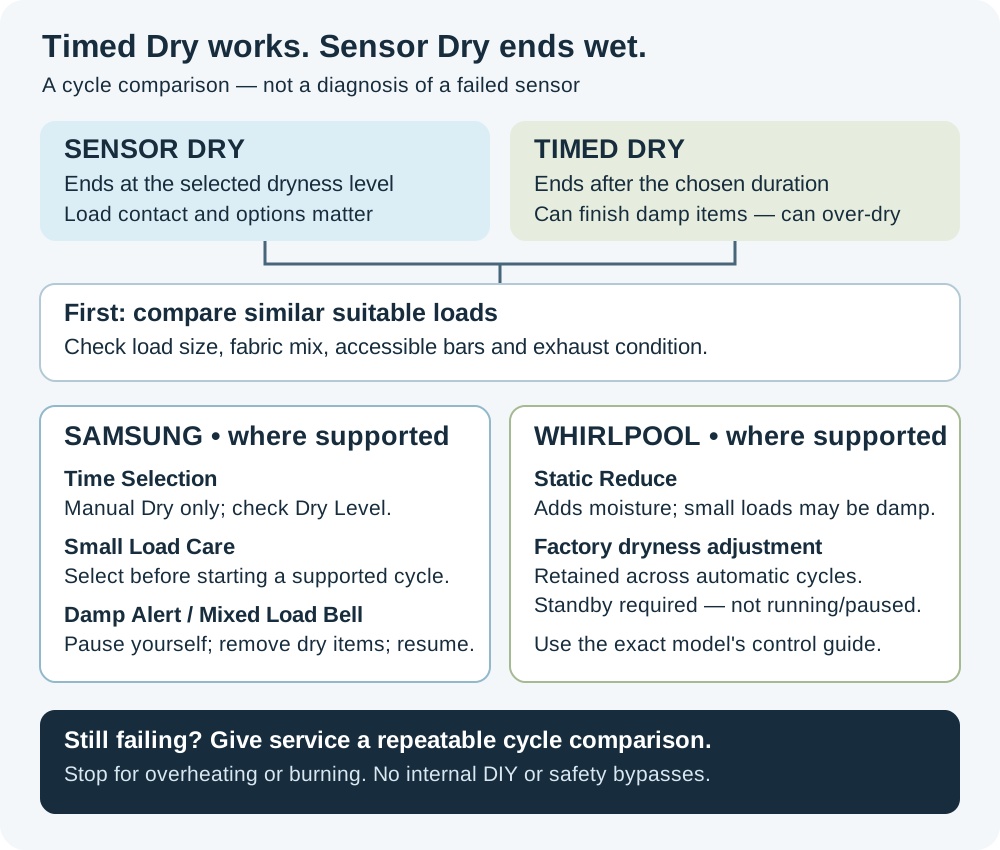
If your dryer dries a normal load on heated Timed Dry but ends Sensor Dry while the clothes are wet, check the load and selected options before buying a sensor. Small loads can miss the sensing bars; some options deliberately leave or add moisture. Timed Dry working narrows the symptom, but does not identify a failed part or prove the exhaust is clear.
This guide covers household vented dryers with automatic moisture-sensing cycles, with separate Samsung and Whirlpool settings below. A setting applies only if your model's manual lists it for the selected cycle. For a drum that stays cold on heated Timed Dry too, start with dryer running but not heating.
Stop using the machine if it smells burnt, overheats or repeatedly trips a breaker. If you smell gas, leave without operating electrical switches and contact the gas emergency service from outside. Do not open the cabinet, bypass a safety device, disconnect a gas line or test live wiring.
Establish what “works on Timed Dry” means
Compare similar, properly spun loads with the same fabric mix and a fabric-safe heat setting. Record the sensor cycle, chosen dryness level, elapsed time and whether the load is uniformly damp or only thick seams remain wet. An empty drum or one nearly dry item is a poor comparison with a normal wet load.
If Timed Dry also needs repeated long runs, investigate drying performance and airflow before treating this as a sensor-only problem. A warm drum and some air at the outlet do not establish an unrestricted exhaust. Check accessible lint and exhaust restrictions safely; have inaccessible ductwork assessed.
Correct the load before changing parts
A few small pieces may not make reliable contact with the moisture-sensing bars. Use the load range in your manual. Samsung's troubleshooting guidance suggests about four regular bath towels as a minimum sensor load; that is a Samsung recommendation, not a universal minimum for every dryer.
Separate very different fabric weights when practical. A light shirt can be ready while a thick towel remains damp. That uneven result needs a different response from every item coming out wet after a very short run.
With the dryer off, unplugged and cool, clean only the accessible sensing bars as the manual directs. Residue can interfere with sensing. Samsung specifies a soft cloth with a drop of mild dish soap for its bars. Do not scrape contacts, dismantle the drum or assume that continued trouble means the bars must be replaced.
Samsung: choose the control that matches the cycle
Time Selection belongs to Manual Dry cycles. If it is unavailable on Sensor Dry, use the permitted Dry Level control instead; an unavailable time adjustment alone is not evidence of a broken panel.
A low dry level can intentionally leave laundry damp for hanging or laying flat. Select the endpoint the fabric needs. Some models offer named More Dry or Damp Dry cycles instead of a separate Dry Level button.
Small Load Care, where fitted, supports certain Sensor Dry cycles for very small loads. Select it before starting: it cannot be selected or canceled once the cycle has begun. Check the manual's compatibility chart rather than assuming every sensor cycle accepts it.
For mixed fabrics, supported Damp Alert / Mixed Load Bell settings signal before the load finishes. The alert does not pause drying. Pause it yourself, remove the dry lightweight items, then resume with the heavier pieces. Availability depends on the cycle and dryness setting.
For separate heating messages or cold operation, see Samsung dryer not heating.
Whirlpool: check whether an option is adding moisture
On equipped Whirlpool models, Static Reduce introduces a little moisture during selected automatic cycles. It is intended for standard-size loads; a smaller load may finish slightly damp. If that matches your result, follow the control guide to leave Static Reduce off for a comparable load before blaming the moisture sensor.
This branch applies to the named option on supported models. It does not explain a dryer that remains cold or every sensor cycle that stops almost immediately.
When every automatic load is consistently a little too damp
Some Whirlpool models allow a factory dryness-level adjustment. Unlike changing the dryness level for one load, this changes the retained default for automatic cycles. Consider it only after load selection, cleaning and airflow checks, when the pattern is consistent across suitable loads.
Check your exact owner's manual or control guide for availability and the button sequence. Whirlpool says the default cannot be changed while the dryer is running or paused: it must be in standby, with power off at the controls. Record the original setting before changing it. Do not apply a button sequence from another model or use a wetter/drier preference adjustment to mask a new abrupt shutdown.
Did this begin immediately after repair or cleaning?
Tell the technician what changed. In one Samsung DV45H7000GW/A2 owner report, a dryer began ending automatic cycles early after internal cleaning and reassembly while Timed Dry still worked. An initial connection check did not resolve it; the owner later reported that properly reconnecting the moisture-sensor connection did. That history supports checking the recent work, not assuming every dryer needs the same repair.
Leave internal inspection to service. Successful Timed Dry does not distinguish a connection problem from a sensor-circuit or control fault by itself. Other owner histories include failed sensor cleaning and failed control-board replacement, so buying parts from the symptom alone is a poor next step.
Finish the load without losing the diagnostic evidence
A fabric-safe Timed Dry setting can finish occasional damp items, but it stops by time rather than the selected dryness endpoint. Check the clothes instead of repeatedly adding a long run: overdrying can increase shrinkage, wrinkling and static. Do not continue drying through overheating or an unresolved exhaust restriction.
If suitable loads still end wet after the applicable checks, request service with the model number, cycle and option names, elapsed time, load description and Timed Dry comparison. Include whether the fault started after work on the machine. That gives the technician a reproducible condition to investigate instead of a request to replace an assumed bad sensor.