A washing machine that drains while filling may be siphoning water through its drain hose, or it may be deliberately pumping water out after a lid, mode or safety trigger. Check when the drain begins before changing parts. Some GE top loaders empty after an extended lid-open pause; some Samsung models drain when Child Lock detects an open lid with an unsafe water level.
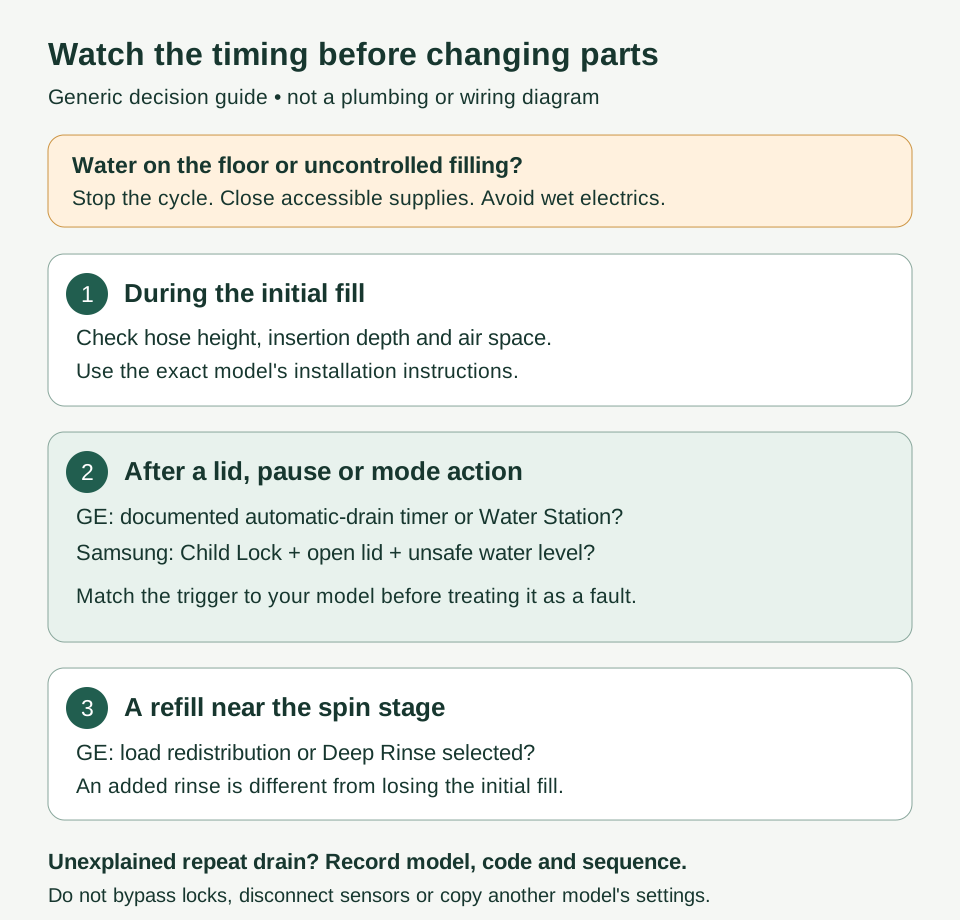
First, stop any flooding
If water is reaching the floor or the tub is filling uncontrollably, stop the cycle and close the accessible hot and cold water supplies. Keep away from wet plugs and wiring; disconnect power only from a dry, safely accessible point. Do not keep running test loads to see whether the problem clears.
Water escaping underneath the cabinet is a leak, not proof that water is leaving through the drain hose. A photograph of the wet area can help a technician, but do not remove panels or reach under a running washer.
Record what happens just before the water leaves
“Fills and drains” can describe several different sequences. From the normal controls, note the selected cycle, the indicator lights and whether the water leaves during the initial fill, after a pause, or during a later spin attempt. Include any lid opening or dial change.
| What you observe | Where to start |
|---|---|
| Water leaves through the drain during the initial fill, especially after installation or moving | Drain-hose placement and air gap |
| Water held in the tub disappears after you leave the lid open | The model's automatic-drain rules |
| Pretreat water drains when you turn the cycle knob | GE Water Station, if fitted |
| A Samsung Child Lock warning accompanies draining after opening the lid | The Child Lock instructions for that model |
| Water is added again after a failed spin attempt | Load redistribution and selected rinse options |
| A long, weak fill ends with draining and an error | Water supply and the exact fill-error instructions |
Pump noise alone does not identify a failed pump. Do not open a locked lid or defeat its latch to watch the water.
If it drains throughout the initial fill
A drain hose that is too low, inserted too far into the standpipe, or sealed tightly into the drain can allow siphoning. Check all three conditions against your washer's installation manual. A hose can be high enough and still be inserted too deeply or have no air space around it.
Keep the supplied hose guide and retaining arrangement in place. Do not seal the standpipe opening with tape, and do not leave the hose end submerged in standing water. Secure the hose as the manual specifies; holding it over a bucket is not a permanent installation.
There is no single drain height or insertion depth for every washer. Top loaders, front loaders and portable machines can have different requirements. If the connection is inaccessible, have the installer check it rather than dragging out a full machine. The washer drainage guide covers related installation checks; water that cannot leave the tub is a different starting symptom.
GE: did you leave the lid open to soak?
This branch applies to GE top loaders with electronic controls and a cycle-selection knob manufactured after August 2017, including the GTW750, GTW685 and GTW680 model families. Check your exact manual for applicability.
On these machines, water drains automatically after the lid has remained open for more than 15 minutes. It also drains after a pause lasting more than 24 hours with the lid closed. An open-lid soak is therefore not a way to hold water indefinitely.
A short interruption at startup is different: the washer sends two brief cold-water pulses, pauses for about 10 seconds, then continues filling. Opening the lid pauses operation; close it and press Start to resume. Avoid repeatedly reopening it while deciding whether filling has stopped.
If the water emptied after the documented pause limit, use the machine's supported soaking cycle or options next time. Draining well before that limit, without another trigger, still needs investigation.
GE Water Station: pretreating is a separate mode
On GE models equipped with Water Station, water used for pretreating does not simply become the next wash load's water. Turning the knob from Water Station to a wash cycle causes that pretreat water to drain. That transition can look like a machine that refuses to hold water.
The lid must be open for Water Station to fill. Close it after pretreating; leaving it open for 15 minutes triggers an automatic drain. Holding Start for three seconds also drains the tub. Do not use that hold action when you intend to keep pretreat water in the machine.
Match the drain to the action you took. Water leaving immediately after a mode change calls for checking the selected mode before altering the hose or ordering a pump.
Samsung: Child Lock can deliberately empty the tub
Some Samsung top loaders allow the lid to open while Child Lock is enabled. If the water level is unsafe, opening the lid can trigger protective draining. On newer models, CL can indicate that Child Lock has drained the water; it is not automatically a drain-pump fault.
Keep children away and follow the model's Child Lock instructions. Restarting the washer does not itself disable Child Lock, even though a power cycle can clear the CL message. A flashing Child Lock indicator may mean only temporary deactivation, not that the feature is fully off. Use the labeled controls and the manual's full deactivation sequence when an adult needs to change the setting.
Do not apply one Samsung code definition to every washer: dC can mean a door problem on one model and an unbalanced load on another. The exact model and what happened to the lid matter more than the code letters alone.
If the extra fill happens near the spin stage
On applicable GE top loaders, an out-of-balance load can cause the washer to slow or stop spinning, add water and agitate to redistribute the clothes. A blinking Spin indicator can accompany this sequence. Seeing water enter again at that point is different from losing the initial fill through a siphon.
Also check the options before using Drain & Spin as a diagnostic test. On GE models covered by this feature guidance, leaving Deep Rinse selected adds a rinse to that selection. A refill during that added rinse does not show that Drain & Spin has malfunctioned.
If repeated redistribution leaves clothes wet, use the washer not spinning checks for the load and spin problem. Do not add an oversized load to suppress the symptom.
A weak fill followed by a drain needs a different check
If water enters slowly for several minutes before the washer empties and stops, record the error before resetting. For Samsung fill errors such as 4C or nF, check the external supply valves and visible inlet-hose kinks. Both hot and cold supplies may be required even when you select a cold wash; follow that model's instructions.
A GE GFWN1000 owner reported that checking the drain route, cleaning the pump filter and trying a reset did not cure a fill-then-drain sequence. Restoring inlet flow eventually resolved that case. It is a reason to notice weak incoming flow, not a recommendation to replace your inlet valve or assume the same timeout applies.
If fresh water keeps entering when the machine is off, close the water supplies and arrange service. Changing the drain hose will not repair an inlet valve that fails to close.
When it started after a repair
Write down the symptom before the repair and the first symptom afterward. “The new board did not fix it” can conceal an important change.
For example, an Amana NTW4519JW2 owner reported that a board replacement stopped continuous pumping, but the washer then filled, drained and stalled. Recalibration and a later actuator replacement did not resolve that new sequence, even though Drain & Spin worked. That outcome remained unresolved.
Give the repairer that chronology rather than requesting the same part again. Internal pressure tubing, level sensing, control configuration and wiring need model-specific checks; do not disconnect sensors or enter service settings based on another machine's repair story.
What to send with a service request
If the installation matches the manual and none of the mode or lid conditions explains the drain, stop repeating resets. Send the exact model number, the selected cycle and options, any code, and a short timeline from Start to the first drain.
Add a photo of the accessible drain connection and state whether water leaves through the hose or reaches the floor. If the problem followed a move or repair, include that change. These observations help separate a plumbing issue, a deliberate protective sequence and a fault requiring internal diagnosis.